Showing posts with label interesting things. Show all posts

Wednesday, June 27, 2012

silver linings

As the title and delay in posting would suggest, it has been six weeks of frustration waiting for some kind of clear plan or purpose for the remainder of the summer and fall to develop.  Here in New York, all the moisture that you might have presumed to have appeared in January and February and coated the ground in ice and snow waited till May and June.  And so we've had to try and slot things in between thunder storms and increasingly tall covers on our training grounds.

We did manage to fit in another group training day at TMT in the third week of May with Jack, Juli, Scotch, Dustin, Lyric, Gabi, Paige, and the League of Extraordinary Gentlemen.  It was nice to see friends again -- and we were blessed with good weather although a little more breeze would have made it perfect.  But we got everyone run and everyone had fun.  The top picture is of Scotch on just his second set of birds -- as I said to Josh, he's still very young and the fire needs stoking but when he gets scent, he knows what to do.  Look at the tail on that dog!  Fabulous.  For young dogs, I prefer to use birds that are fully awake and placed in spots that require the dog to use its nose.  For younger dogs with less prey drive, I think there's a lot of merit in a handler 'taking the dog for a walk' close to a planted bird -- in part because the young dog associates going with his handler with the excitement of finding birds.  And as the dog associates going for that particular kind of walk, that will also build drive as well as reinforce the desire to work with his handler.

After a great winter starting the breaking process with Jake, we lost our rhythm due to crappy weather coinciding with my days off.  He has been at the point of making the transition from the pinch collar to the e-collar for correcting him when he makes a mistake (ie. fails to stop or needs to be re-cued to stop) for some time -- and my challenge has been that he was simply not making very many mistakes.  Jake seems to have internalized all the external cues for stopping -- pointing, stopping to flush, and honoring -- and was standing very nicely through each of those things while either someone else flushed for him or the dog he was working behind.  In short, he wasn't doing anything to merit being re-cued to stop and stand still.

As I wrote two summers ago about knowing when to stop and when to keep going, my dilemma has been whether to assume he does know it and potentially create a problem by going too fast or to potentially lose style by boring the dog with lessons he knows he knows.  One nice part about the West method is that you're essentially teaching the dog the same skill in a variety of scenarios -- which is to say, you don't break the dog pointing birds, then teach the honor, or the stop-to-flush -- and so in that sense, you can mix things up with the dog by asking him to the same thing, albeit in a different (and hopefully interesting) set of circumstances.  Maurice Lindley had suggested that I use the stop-to-flush as the means to test whether he'd internalized the e-collar cue to stop -- in part because I could do it by myself using a launcher while still keeping myself in a position to correct him with the pinch if the e-collar didn't register.  The challenge remained that he would stop himself properly and then, very often, make little or no effort to move after the bird.  Nevertheless, the advice was sound.  What I've also seen with him is that he seems most reliable on birds he's not pointing, whereas having scent drives him that little bit crazier even if I'm standing by him with the pinch collar and someone else is flushing for me.

Today's silver lining was that I got up to TMT to feed my birds and hopefully get some training in on pigeons with Jake and discovered that, of the five checkcords that I can think of that I own, I didn't have a single one with me -- and certainly not the one with the pinch-collar on it.  I didn't know whether to laugh or cry.  So I cursed.  I had been tidying up all the stuff in the back of the truck and in the trailer and had just plain forgotten to make sure I had one or the other in the truck again.  I had already put out one pigeon in a launcher and two on cards but debated what to do.  The short answer is that part of me wishes I'd brought a camera with me to get some nice pictures of me in front of a high and tight Jake, but then again anyone who reads this blog would have laughed their butt off if they'd seen his regular purple nylon leash hanging off his collar.  He handled his stop-to-flush perfectly, broke on the first pointed pigeon after I'd flushed but I managed to stop him with the e-collar to style him up and reflush the bird, and he handled the final pointed bird really nicely.  And this is one reason I have been frustrated by our intermittent training schedule -- because he handles corrections really nicely -- and wish we could have gotten a bunch of nice even repetitions in.  This is largely what you pay a pro for: the time to establish a routine of (hopefully) productive behaviors.

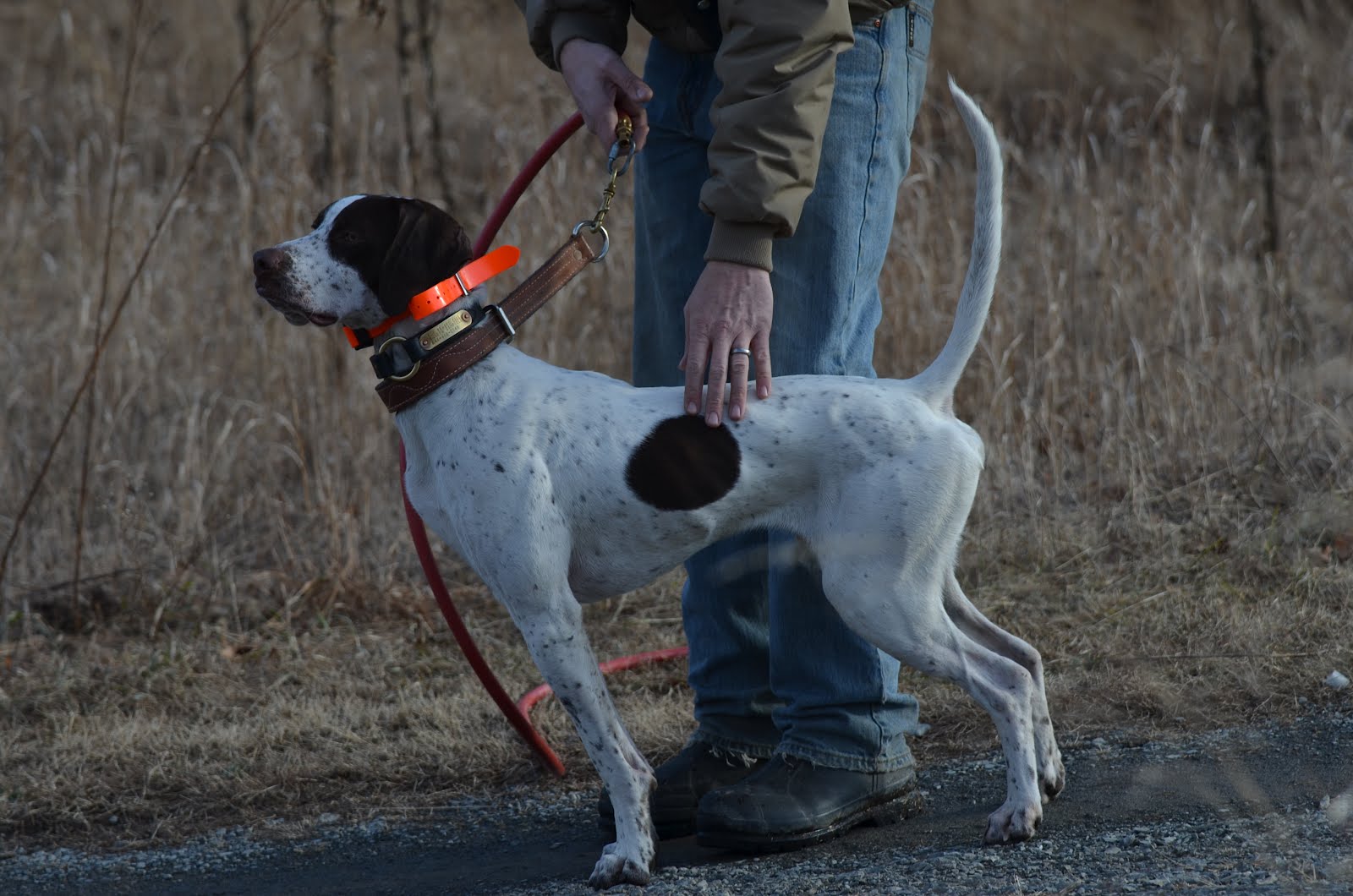
But the real silver lining wasn't that Jake did well, but that forgetting a key piece of equipment that I would have otherwise used as a psychological crutch in the name of 'taking it slow and steady' forced me to take a chance.  Sometimes you need to have faith in yourself, in the training time you already have in, and of course in your dog.  This picture is actually from a couple of days ago, but he's a pretty happy chappy.

*******

In other news: Craig Doherty at Wild Apple Kennel has written a series of five blogposts on grouse trialing.  Whether you do grouse trials or not, there's a lot of really useful and interesting stuff for trialers in here.

And: I had a nice time judging SH/MH at the Nutmeg GSP Club hunt test a couple of weekends ago and was pleased to watch another set of really nice Spinones.   I realize I'm admitting to a stereotype-proven-wrong, but if there was a breed that has genuinely impressed me in the last year of judging hunt tests it has been these mostly white Spinones.  And not because they performed the skills well enough, but because they looked animated and excited to be doing it.

Also: if you ever send something back to Garmin to get fixed, remember to take out your memory cards or the after-market extended antenna.  I remembered the first but figured they'd just repair the busted screen on my Astro 220... no.  They sent me a whole, newly refurbished 220 back instead.  Fortunately, this is now my back-up unit and the 320 comes with an extended antenna in the box.

Saturday, March 3, 2012

short days and a chance of snow

Meg and I just got back from our annual February vacation. We had entertained going to Morocco for a while, but for those of you who follow this blog know, we have a perverse fascination with going to cold places in mid-winter. And so, we went to Iceland. Of course.

I don't mind admitting that I have had an Iceland fixation since reading my father's copy of Desmond Bagley's Running Blind in the late 1970s. I haven't read the book in maybe thirty years, but I can tell you that there might have been all kinds of references in that book to active volcanic activity (like the creation of the island of Surtsey in 1963), but I remember river crossings, Land Rovers, and that the Russian KGB agent drank calvados. In any case, compared to our flights to Mongolia, the Ukraine, and Sweden, a five-hour direct flight from JFK to Iceland looked both easy and, frankly, cheap. And admittedly, while the population of Iceland is only about three-quarters of the population of Staten Island, and so small scale makes things a lot easier to coordinate, Keflavik is one slick airport some 31miles from downtown Reykjavik. Stylistically, it was reminiscent of the Ikea-type experience we had in Stockholm despite its shared history as a big-bomber USAF base. Buses to and from the airport are coordinated with the flight schedule so while there are taxis waiting, there's actually really no point to taking one unless you're going someplace other than Reykjavik.

As with our trip to Sweden, we decided to base ourselves in one place and make short overnight trips elsewhere -- in this case, staying at the Radisson Blu 1919 downtown which was perfect for us. (I just made the mistake of looking at some people's reviews of this hotel and am a little surprised by some people's expectations: it's an urban Radisson, it's not a boutique froux-froux hotel; it's in Scandinavia, what kind of decor do you expect?; it's a downtown hotel on an island in the middle of the North Atlantic, would you like cheap with that, too? please don't go out to eat anywhere because that will really wreck your budget; room check-out is 12noon, how is housekeeping going to get your room ready when you arrive four hours before that time?) In short, the location is great to walk to museums, shopping, restaurants, and probably even the bus station if the weather was a little nicer; the staff were unilaterally extremely helpful and imminently more fluent in English that we will ever be in Icelandic. That latter observation goes for Icelanders in general, too, and when you do completely mangle a place name, they all seemed to laugh it off with a lightness that comes from a certain cultural self-confidence. Incidentally, the first picture on the right is taken from the top of the Hallgrímskirkja, the striking Lutheran church in the middle of the city. The dark-grey boxy-looking structure three-quarters of the way up the picture is the Harpa, Iceland's new, premier concert hall. I can only describe it as being like a TARDIS: on the outside, it is certainly innovative with its angled panes of colored glass that mirror and mimic the sea that surrounds it, but once you get inside, it is massive and light at the same time. And I just saw that Buika is playing there in early June -- might be time for another trip!

In addition to a couple of side-trips to the Vestmannaeyjar and then to the peninsula we abominated to 'Snuffaluffagus', and after our equine excursion in Sweden, I was determined to ride an Icelandic horse in Iceland. From what I gather, Eldhestar might be the largest horse-riding outfit in Iceland and, whether cause or effect, actually does offer riding year-round, is close enough to Reykjavik that they'll pick up at your hotel, and has access to enough space that you really do get ample opportunity to get your horse up into a tölt. I wanted to ride and have sat in a cold saddle enough that if I'm going to do it, I'm getting as much saddle time as I can. And my darling wife is a trooper -- and as you might imagine, we were the only two people signed up for a full day-tour. (There were actually a bunch of people who came through for a one- or two-hour ride while we were there which was pleasantly surprising.) Meg was pleasantly relieved that we would come in for lunch after about four hours and that she could then stay inside and stay warm. This was especially relieving after we watched our ridiculously upbeat guide literally break the ice for us on our way back in to the stables: we had to cross a slow-moving, but three-foot deep creek with pretty solid ice shelves on the entry and exit; after coaxing her horse into and across the river, it decided to try to stand up on the ice shelf on the exit, stumbled, and dumped her. But here's the happy picture of us all bundled up in our coveralls. (Incidentally, to protect the indigenous horse population of Iceland, you cannot bring used horse tack or clothing into Iceland without a certificate of sterilization from a vet.)

I don't know if it was anything other than the remarkable pictures in the various Rough Guides and Lonely Planets that made us decide to go to the Vestmannaeyjar, but we're sure glad we did. Truly an an archipelago, only the largest island, Heimaey, is inhabited and dominated by its safe harbor and fish processing factory. But the northern end of the island, and which provides such a safe harbor for its fleet, is surrounded by high cliffs that seem somehow more Pacific than Atlantic. This picture is looking northeast from the edge of the lava field from the 1973 eruption of the Eldfell volcano towards Elliðaey and the massive Eyjafjallajökull glacier, also infamous in recent history for being the site of the 2010 eruption that disrupted plane travel across Europe for over a week. Being on Vestmannaeyjar in February was a little like being in Mongolia the first time: while no-one (understandably) asked to touch my beard admiringly, we were the two tourists. There was a Japanese guy there, too, but he was there to buy 'caviar' (which I took to be roe) from the fish plant. We were nevertheless treated with the utmost hospitality, almost apologetically in fact, by the brand new owners of the hotel we were staying at -- apologetically because they had literally just taken ownership of the hotel, were in the midst of renaming it and literally tore out the old dining room while we were there. But their kindness and introduction earned us a free car tour of the island from another friend of theirs (which was appreciated because it was raining when we first arrived) and a ride to the far end of the island the next morning. But it was something of a Central Asia experience: we wanted to go into the Folk Museum but being winter, it was only available by appointment. It was in the public library so Meg, with her usual aplomb, just asked if we could get in. The curator was off-island, but a trusting surrogate took us up, turned on the lights, and then left us alone to wander through (and in that regard, it was not like the Aimag museum in Choibalsan where we were shadowed by a Mongol grandma who turned lights on and off as we entered and exited each room). And so we learned about the history of the fishing industry, the Turkish pirate raid in 1627, the 1973 eruption (which had a great video collage of survivor's reminiscences, and the surprising percentage of Vestmannaeyjar residents who made their exodus to Utah to join the Mormon Church. While it took even the very helpful receptionist at the Radisson four phone calls to figure out the details (it being winter even website updates get delayed), the Vestmannaeyjar were easy to get to by bus and ferry from Reykjavik to Þorlákshöfn. Like any small island destination, I probably wouldn't want to go there in summer to avoid the extra people -- but having the place to ourselves albeit with a fair amount of drizzle was just fine.

After another brief stop-over in the big city, I got to fulfill my Desmond Bagley fantasies and we rented a Land Rover Defender to drive up to the Snaefellsnes peninsula to stay at the Hotel Budir. All hype aside and the fact that from the exterior the hotel looks a little boxy and otherwise not too distinctive, this was a fabulous place. Cosy, exemplary customer service, and the food fantastic. And the location, on a river estuary, with a view of the waves breaking on the beach from the lounge, and a backdrop of steep-sided mountains topped by Snæfellsjökull, the mountain and adjoining glacier. The picture on the right is of the old Lutheran church and graveyard a few hundred yards from the hotel, the walls of the yard made from lava boulders topped with sod.

Leaving aside my boyhood memories, we had rented a Land Rover because it was winter, after all, and the weather unpredictable. Happily, too, I have driven in snow in Maine, Michigan, and Oregon -- otherwise, even with studded snow tires and 4WD, I might have soiled myself coming over the mountain road to Ólafsvík on the northern side of the peninsula. It wasn't that it was snowing as much as it was a winding road with no guard rail covered with ice that you could see was at least an inch thick in places -- oh, and it was gusting about 40mph. And then the road went from hardpack to gravel about three-quarters of the way down. Time for third gear all the way down. I had forgotten that Snæfellsjökul is the origin point for Jules Verne's A Journey to the Center of the Earth (1864), but I am not surprised; nor were we surprised to find The Hobbit Inn in Ólafsvík. The whole vacation was a little bit like being in a Peter Jackson film. However, in another Mongolian moment, reminiscent of the ginormous long-wave antenna in Bayan Olgii, we also saw the massive radio mast at Hellissandur, the tallest structure in Iceland. The picture on the right was taken on the beach below the radio mast and illustrates the wind speed pretty clearly -- but it was really neat to walk on a black lava pebble beach despite the gale-force gusts.

Incidentally, the best town-name-for-a-death-metal-band was also on Snaefellsnes: Hellnar.

In short, we had a great time, saw some incredible scenery, stayed in nice warm hotels, and ate like champions. There are several very good restaurants in the downtown 101 area of Reykjavik: our favorite was Fish Company. I like actual food and will admit skepticism towards foams and vapors and freeze-dried who-knows-what à la Ferran Adrià -- but leaving aside how good all the hormone-free, fresh-caught meat and seafood tasted, my deconstructed tiramisu was phenomenal. Twice.

Sunday, January 29, 2012

happy new year

Since I last wrote, we've only been able to get out and train a couple of times with the League. Between trying to find windows in the weather and coordinating various friends, it's been a challenge. Arguably the biggest hurdle to training using the West method is one of manpower -- and it is no wonder that a lot of folks migrate to something like the Rick & Ronnie Smith method with its utilization of 'whoa posts' and such. And I mean no disrespect to the Smith family who have trained more great dogs than I ever will -- but I have seen the West method and it makes sense to me. Even though Maurice Lindley has figured out ways to train dogs by himself using the West method by using launchers, I know that he prefers to work dogs with a group. Fortunately I have been blessed to have found friends with broke dogs to work behind and others with puppies who can also flush and shoot.

I recently wrote a small piece for a Vizsla Club of Long Island newsletter which, in short, hopefully encouraged folks to get their dogs out and do fieldwork with them. One of the highlights of our training trips has been watching Jeremy and his puppy, Jackson, really come along as a tag-team. Jackson is from the most recent litter out of our friends', Jen + Dennis Hazel's, Sally. His whole litter are looking like bird-finding machines and there is no shortage of drive in this little dog to the extent that I asked Jeremy what he wanted to do with his dog -- did he want to play the field trial game? did he want him to be a hunting dog? These aren't exclusive categories, but to my mind I'd develop a pup a little differently if I knew I wasn't going to play the trial game. As I've said in previous posts, my goal with Jake was to establish a handle on him -- but if I had also intended him to be primarily a hunting dog, I'd also be working on limiting his range when I turned him loose. (And so, for example, when Jake lights out on a cast when we're out for a walk, I keep singing him out and only really reel him in if he's headed off in a drastic tangent or headed behind me.) I think it's also easier to encourage a dog with drive to stretch once they're broke, than it is to try and hunt with a free-running, green-broke dog. And so Jeremy and Jackson have been doing long-line work to really encourage the pup to go with him and not hunt independently -- and in doing so, to be rewarded by bird contacts.

We had run Jackson on johnny-house quail and after still managing to catch a couple and seeing his intensity, we decided it was time to get him on a checkcord to develop his handle and nurture the idea of working with his handler. The last time we got together (which may have been two weeks ago), we tried using chukar with flight limiters -- but the challenge I've had doing that is that there is a huge variance in the relative strength of chukar and if you weight the limiter too much they can barely fly and then you end up with a very expensive, dead training bird, too little and you lose both the limiter and the bird. And to my mind, the goal at this point is to have birds that will fly promptly when a pup charges in on them (and have the checkcord stop them after the flush, not before). Because Tom's property is much more wooded than the desert plains of Arizona, I was wary of using carded pigeons -- but decided we would give it a go. Now sometimes it's important to make your own mistakes so you know why the guy you've spent three months apprenticing with in the last year does something the way he does. And that thing is: don't sleep the pigeons. We had some concern the pigeons might disappear before Jackson and John & Linda Morris's pup, Dustin (whose handsome picture is alongside), or that if the pups came across the birds walking in the open they might be less inclined to point and more inclined to chase. But here's the thing: if a dog tries to chase up a healthy bird and it flies when the dog gets too close, the bird will get away and then the dog will get checked by the cord; if the bird can't escape quickly enough because it's dizzy, the dog maintains the hope that it can grab a bird on the ground and will probably keep trying longer.

This was where I was with Jackson, concerned that he might be turning into a diver, emboldened by his successes. And I mean this as no slight on him or his owner, but this is a young dog with a ton of drive and if others will read this and see parallels in developing their own dogs and so avoid a few hiccups, then all of this disclosure will have served its purpose. And so, Jackson got to run on fully awake carded birds -- and as much as I will try to encourage young dogs to find their first birds with their noses, the important thing to consider when beginning to encourage a younger dog to establish a solid point and stand is that whether it's a hunt test or a hunting situation, if it comes across a bird in the open, it is still expected to sight-point. But whatever it was about the pigeons, whether they were deep in tall grass or walking in the road, they stopped Jackson in his tracks. And he stood really nicely all the way to the flush. I was so very pleased with both Jeremy and Jackson. The next question for Jeremy is how he wants to break his dog now that we've started down this path.

By contrast, Jake has started down the West method path and is doing great. This was his third time being worked behind John's Juli -- a very pretty dog I have been braced with and who I was fortunate to judge in both SH and MH. And it was great to have Jeremy there to be the designated gunner so that Juli could also get a nice chukar retrieve or two. The amazing thing with the little white demon (who has now weighed in heavier than Jozsi!) is his natural inclination to honor -- and sometimes from so far away that he has already figured out the context for a situational honor. Again, while a judge might ask him to move up in a hunt test sensing it was not a true honor of another dog's point, in a field trial a situational honor is as good as any other -- and I'll take it. What I hope this picture (courtesy of Linda) illustrates is multifold: first, this dog has style; second, he is wearing all his work clothes -- his e-collar and his pinch-collar; third, that there is very little tension in the actual checkcord and collar as evidenced by my loose grip; and fourth, that he is being rewarded by two things for standing still -- the sight of a bird being flushed and a gentle reassuring pet before being moved on. At this point, I touch him more than Bill does, meaning that if a backing situation is becoming complicated and taking time, I will gently stroke his side in the middle of it in addition to petting him and tapping him on the side to move him on once we're done with a situation.

To round out things: I've been trying a new twist on things with Jozsi, adding a little more pressure and adding a much bigger reward. If it works out, I'll post specific details -- but suffice to say, he's being kept to a higher degree of honesty and in return, he gets birds shot for him which he then gets to retrieve. He is broke in practice, but I think that once he's actually broke in his head then all his tail issues will disappear -- which is to say that I think while he knows what I want, he hasn't settled the issue in his own mind that this is also what he wants to do. On the upside, while it's not quite a Master Hunter quality retrieve, his retrieve is solid, to-hand, and will hopefully satisfy field trial judges should he get called back.

Like Bill said to me, two summers ago, "If you can get him straightened out, you'll be able to genuinely call yourself a dog-trainer." If breaking Jake is all about starting a dog right the first time, then Jozsi is a conundrum that is so very worth the challenge. I love all three of the Gentlemen albeit for different reasons, but Jozsi is such a goober that you can't help want him to be fantastic.

Tuesday, October 11, 2011

work finally paying off?

Since I owned up to not being the calmest dog trainer on the planet, a whole lot has gone on. First of all, Her Majesty, Widdershins Skypoint Capo, came back from Arizona after Bill was kind enough to finishing breaking her for me. As with Jozsi's return last year, she flew direct from Phoenix to Newark through Continental's PetSafe program and arrived in fine shape. As one indicator of what kind of environments she was being kept in before, during, and after her flight, the waterbowl that Tamra had frozen for her was still three-quarters solid when I picked her up.

Once again, the headline you'll never read: "Healthy female vizsla arrives safely at Newark airport!"

With The Road Crew reunited, I immediately loaded them into the Luxury Cruiser and headed up to TMT to get in a morning's training before turning right around and heading south to the Conestoga Vizsla Club trial down in Clear Spring, MD. We met up with Jeremy and Jackson again and immediately began by running the little liver dog through his paces. As you can see in the picture, he is showing a great nose and some very nice style at 12wks of age. Once again, he got to make a retrieve with the birds not wanting to fly in what was a 90% humidity morning. His future is very promising.

Then we put down Her Majesty in an effort to remind her that even though places and faces had changed the rules had still applied. In this way, I feel spoiled. I know how Bill trains, I know how the dog was broke, and I know how to keep her honest and maintain the training so that at whatever point it will become second-nature to her. And as I've said to a bunch of folks in the last couple of weeks or so, the beauty of the West method as practiced by Bill Gibbons is that, even if she messes up, there's no hooting or hollering. I had said this to Jeremy before we went out, to think about how different what he saw the previous week and what he'd see with me working Capo would be. And he did. As should be expected, she tried to bust in on her first bird, got corrected, broke on the shot with her second bird, got corrected, and then stood like a million dollars through all the hoopla of trying to get two running birds into the humid air. Not a word was spoken. All we got to watch was a jacked-up 19mos old vizsla working birds.

With the West method what I've come to realize is that in the absence of any handler theatrics, even if the dog is imperfect, all the focus remains on the dog. Whether you're a hunt test judge or a field trial judge, or simply a guy watching someone else's dog hunt, your eyes never come off the dog standing, you're never distracted by a handler pleading, cajoling, or bullying their dog. Jozsi ran next and while there was still a little tail ticking till I got to him, he stood his birds beautifully and honestly despite having plenty of opportunity to roll out of sight and commit a felony or two. Momo, too, did a nice job -- this great point in truth being a long, long sight point on a pair of birds walking together some 40yds away. Jeremy and I spoke about this, about dogs' color-blindness relative to humans (not that it really helped us last week as we walked right past the hen quail buried in the dead leaves and then noticed Jackson had stopped and was pointing it), but that their eyes have proportionally much higher percentage of of rods in their eyes and a much higher flicker rate, or refresh rate, giving them a much higher ability to detect even small degrees of motion in the world ahead of them.

Luisa or Janine: if I've somehow gotten this piece of canine physiology wrong, please correct me in the comments below.

We then hauled ourselves down to northern Maryland to the Indian Springs WMA. I hadn't been here before and was a tad concerned that it looked pretty compact for running trials at. Compact it is, especially for anything closely resembling a true All-Age stake, but there are enough fields and edges that each stake could be run on a slightly different course -- and with Blair Lake on one side and a rising ridge of hardwoods clearly in the early process of turning, it was a beautiful spot. All the same, while some cutting and management had clearly taken place, it was clear that it had been a warm, wet spring and the cover was very high in places. And while the temperature cooled while we were there, scattered showers were largely interrupted by rain all weekend. It was a great weekend to have an abundance of long riding coats -- but despite the weather, the dogs all did well sleeping in the Luxury Cruiser and I was perfectly comfortable sleep in the back of the truck under the cap.

Jake did a nice job in Open Puppy, showing no signs of being at all unnerved by being handled from a horse for the first time nor any indication of interest in his bracemate -- both great for a 7mos old dog. As I've said previously, my initial want for Jake's development was to build a relationship and establish a handle and then encourage him to run far and wild. And while his range was moderate, he dug into cover when he felt the need, would pop out to the front at appropriate times, and handled like a charm. It was a very nice start that earned him compliments if not a ribbon in a fairly large puppy stake.

For her first trial, Capo also more than acquitted herself -- handling nicely even with a relative stranger. By the time we got to the backcourse, she had really started to open up, rolling out along the eastern woods line. She then disappeared and the judge and I both knew that she was standing someplace -- and then she reappeared and brought me a feathery present, directly and gently to hand. We had run out of course and so the judge alerted me that we could turn back -- at which point, she promptly nailed a point looking like the Million Dollar Baby. The judge gave me the option of collaring her and trying to flush the bird, but I elected to treat the whole situation as if she were a truly broke dog. She stood through the shot and then broke and retrieved her bird to hand. This earned her a 3rd place ribbon, a nice testament to a very promising dog.

While I would have loved her to have acted completely broke, she is still a mere 19mos old. And the best part about the whole situation is that I know exactly how to review the lessons she learned this summer and so we did so on Monday morning after the trial, again progressively improving from grabbing the bird, to breaking on the shot, to standing high and tight all the way through. While the picture above shows how nicely she'll self-stack, this is how she sets up on birds, too.

Open Gun Dog was the actually the first of the stakes the Road Crew ran in and it was raining softly throughout the stake. Jozsi ran in the very first brace and on a course that the judges were not entirely sure of to start with. I think having to make mid-course corrections actually worked in our favor because if there is one thing that I can rely on all my dogs for, it's to handle for and with me. His bracemate was picked up for an infraction around the 5min mark and that, too, probably worked in his favor -- or, at the very least, and in contrast to Momo, causing him no detriment. Jozsi doesn't need a bracemate to make him run hard and so we did our best to look like a well-synched team. Birdwork was at a premium for the entire stake and Jozsi established the precedent by not making bird contact till the 28min mark. There was a little tick in his tail as I rode up to him which disappeared by the time I dismounted. The bird went up, all was in order, I took him on, the brace ended shortly thereafter. On the Jozsi scale it was about a 7.5 out of 10, but truth be told it was also only his second, clean broke dog run. And I was pleased.

Momo went out in the fifth brace and was braced with another lower-powered dog. Both hunted nicely, but neither really got out there. With time coming on, I took Momo back to the same spot that Jozsi found his bird and he made contact, too. His bracemate honored him, all was in order, and the brace ended shortly thereafter. I was pleased with him -- and while I knew only a few dogs had made it round with birdwork to that point (and did all day, in fact), I doubted he'd end up with a ribbon.

But the highpoint of the day was hearing Jozsi's name mispronounced as the winner of the OGD stake at dinner that night. I have deliberately not run him a lot in the last two years because I don't need to try and show a dog that I am not proud of -- and while I would rather he fail gloriously than lay down the mundane, I also didn't need to keep paying entry fees just to watch him blow me off. But to have him take a four-point major towards his Field Championship after carrying the day from the first brace despite strong performances from some local favorites was a real treat. The bittersweet moment is that I no longer have the opportunity to call Lisa DeForest and tell her how proud I was. But I am grateful to the Semper Fi crew for letting me join their toast and remember her in the process.

*******

This past weekend we went to the Finger Lakes region of New York to celebrate our wedding anniversary and so that Meg could test herself one more time in a ridiculously long running race, the CanLake 50. The race features both a 50mile and a 50K race, the 50K folks joining the super-crazy around the 19mile mark. Unlike the previous 50K she did two years ago, the CanLake 50 is all on roads and follows a counter-clockwise route around Canandaigua Lake and compared to her previous race relatively flat (a mere 2200ft of ascent as compared to the approximately 5000ft she experienced the previous time). One side-effect of this was that Meg bested her previous 50km time by over 3hrs! As she'll say herself, she's not fast but she'll get there -- a great illustration of why the tortoise will beat the hare. At the end a number of folks commented on how well she looked during the race.

I pulled a hammy slightly doing a trail run with the League at the awesome Wesley Hill Nature Preserve in an attempt to get them exercised between meeting Meggers at the aid stations at 9.6miles and 23.7 miles. I love places that state that 'dogs under full control' are welcome, not 'dogs on leash' but dogs under control. A good argument could be made as to whether field trial dogs are actually under 'full' control, but I like the logic that says that a dog on a leash is not necessarily under full control either. In any case, the League ran there three days in a row -- and heaven knows, Jakey loves running in the hardwoods. And I am glad that I had an Astro and that he has a handle on him. Zoiks. He needed a whole day to recover from all his exercise once we got home. But here is a nice picture of him looking out on Honeoye Lake early one morning. I don't know if the Iroquois have a word for fog rising off water, but from living in Portland, OR, and kayaking on the Columbia, I remember that in Chinook the word is 'skamokawa'.

Thursday, September 15, 2011

just geting warmed up

It's hard to believe it's been over a month since I posted last -- and heaven knows,things are going full steam ahead already. Hunting season may not begin for a couple of weeks, but the hunt test and field trial season has already. The League and I just got back from a great weekend out on the Cape at the second annual VCCNE/Mayflower doubleheader hunt test. None of the Gentlemen were running (and more on that), but I had volunteered to gun for both clubs and judged JH for Mayflower on the Sunday afternoon. The League did a great job hanging out at theLuxury Cruiser for most of the day, but making good use of the cool weather at dawn and dusk to stretch their legs and work the leftover birds. The first picture is courtesy of Julie Smith and shows Momo using his usual Jedi Mind Trick on Gordon to get the attention he thinks he is entitled to.

This was the first weekend of taking the Luxury Cruiser for a weekend event and sleeping in the back of the truck. While space was a little cramped, it seemed to work pretty well -- especially after I'd resuscitated my Coleman two-burner stove and had remembered to bring all the accoutrements to make a solid cup of Turkish coffee. With the good weather, having the stake-out chain really made things a lot more enjoyable, I'm sure, for the League -- and having dogs that are used to it makes it
a lot more enjoyable for me, too. Jake's ability to just roll with whatever is happening continues to amaze me.

Taking a step back or so, it's been a great month to really get to know Jake. As frustrating as the summer was
for everyone remotely affiliated with the Wallow Fire, not being able to run him frequently or expose him to birds foralmost two months had me wondering 'what if'... and heaven knows, his sister Dot won her first Puppy stake the day she turned six months old. But the fact is that there is a time for every dog -- and I think we have plenty with the Dancing Pirate.

Living with three hunting dogs has proven interesting: we have definitely had to institute a more regimented schedule for us and the Gentlemen. After their breakfast (Momo and Jozsi just get a small handful of kibble after their morning run, Jake still gets a solid cup-and-a-half in the morning) and after their dinner, they have crate time to let them digest and to give us time to get our own food. Once we've eaten they get supervised playtime, although last night was the first night that Jake actually abandoned wrastling either Momo or Jozsi and came over and lay down on me on the couch, much to Jozsi's chagrin.

In an attempt to let Meg get a normal run in first thing in the morning and to give me the chance to really work on developing a rapport and a handle on the Jakeasaur, I've been taking him out by himself in the mornings and really letting him run in the woods, albeit with both an e-collar and an Astro. There'll be a few words on e-collars at the end, but I have been frustrated by the Astro's sometimes inability to combine correct range anddirection. I did purchase an extended antenna for the DC40 collar and I see now that the long-range antenna that comes on the new Astro 320 is now available as an accessory upgrade for the older 220. I have not been necessarily looking for more range, but more accurate communication between the collar and the receiver, and to that end have also experimented with re-tuning the frequency between the two units. In theory, shorter wavelengths (and therefore higher frequencies) can pass between obstacles more easily and with less corruption of the signal. And so I re-tuned the Astro to its highest frequency range; oddly, Garmin doesn't tell you how to do it in their manual, but it can be found in various places including here. Those two changes did make some difference, although at this point I can now tell that we have pending thunderstorms when it loses some of its normal accuracy. Having the Astro really lets me work on encouraging Jake to range and cast even after I've lost sight of him -- which in our woods is often soon after 30yds out. On our trail system, he does have some favorite spots that he really likes to explore -- and being able to not panic, and instead keep singing him out once he's hit 100yds+ is a real bonus.

He has had one run at Flaherty already, but the grass was so high in the spotwe went to that he couldn't hardly range and was suitably exhausted and abraded after his time on the ground that he slept wonderfully that night. He did also get to run at Crane this past weekend -- and it was pretty great to run him on wild-planted birds and watch how he dealt with new types of cover and tons of old scent. After his first bird contact, he certainly kicks it up a notch and, as a result, having a pretty good handle on him already is a bonus. In addition, I have been able to get my Evil Empire set up and birds acclimated to their respective drums. Today was the first day I released a couple from each barrel and left the recall doors open -- that a hen was already waiting to go back in when I went to open one of them. Hopefully this will be the first of many successful recalls -- I really do think it makes a difference using wild-planted birds, especially if you have stocked your johnny-houses. The two areas we need to work on with him are breaking him to the gun and running from a horse. I'm waiting till he is chasing, not merely following, the bird to the point that he is about to grab it to fire the gun. I've been able to do it a couple of times with a 209 in a single-shot .410, but one of the challenges in the place I train is that it is in the woods and if a bird flies behind a tree where Jake loses sight of him as he chasing, he'll just stop and either try to get a scent or come around in search of the next one. Again, there's a time for every dog and doing it right the first time means not having to take more time to rehabilitate a gun-shy dog.

He met Jen + Dennis's horses at Crane this past weekend, but time just didn't allow for me to take him for a jaunt and I'm hoping to have that opportunity this coming weekend. But this is the beginning of the season, the trial and hunt test season as much as hunting season -- and I'm looking forward to judging for theWestminster Kennel Club hunt test at the end of the month, then heading down to Conestoga to judge their Hunting Dog stake with my good friend, Michele Dowd, along with running all the members of the League as well as a newly-returned Miss Capo. The Road Crew reunited!

*******

For some reason, it seems that the debate over e-collars has risen to the top again, maybe only in my world, but Pat Burns also felt the need to write a detailed (and to my mind, balanced) post about e-collars as a training tool. And from an e-mail exchange with
Janeen over at SmartDogs, she said this: "Good working dogs, those bred to do specific jobs brilliantly well, have incredibly strong behavioral drives that both work for and against their human partners. When those drives are emitted as dissenting opinions they put the true working dog at odds with the job he was bred to do and there is no reward strong enough to break that focus." Janine remains one of very few folk who I know who has actually researched the 'research' about e-collars. But like Donald McCaig wrote in a comment to Pat's post: "But there is a substrate of the pro and anti ecollar argument that quelches rational discourse."

As for the guy who yelled at me last night for running my dogs off-leash at dusk in the park who got to watch a pointer turn on command 15ft from him without using the e-collar (but still having it as back-up): bite me!

Sunday, August 7, 2011

thwarted

The short version of the story is that after a phone-call from work asking if I could come back earlier than planned, I did. After seven weeks in Phoenix in a holding pattern and no concrete assistance from the USFS till literally the day I left, it was an easy decision to make -- and made easier with the support of Bill. As he said, if he'd had 25 dogs to break and no other help, it might have been a different conversation -- but as it was, and in this economic climate, a job is a job.

I certainly learned a bunch of things, albeit mostly things I hadn't planned on. Namely, that I don't think I'll be becoming a professional trainer any time soon -- any residual glamor or romance that might have remained from last summer has dessicated and blown away. This is a tough life for the best of people, especially for a pro who is campaigning dogs and on the road for large chunks of time. I've said it elsewhere, but if I go to a trial and see a pro there with their family helping out, I'm immediately impressed. After seven weeks, I did learn that I could probably enjoy owning and operating a boarding kennel -- which is useful for Meg and me to keep in mind for our next move. I also learned that, in an ideal world, a pro owns or works directly for an owner who owns their training grounds -- being at the mercy of a federal agency as well as natural phenomena like fire will test the patience of a saint.

As a testament to the kind of class act Bill is, though, he did offer to keep Capo in AZ to finish her getting broke -- which was a huge relief to me because of the four-member Road Crew she was the one dog getting worked and making progress. And so we will wait till mid-September to see how much progress she's made. Now that they're home, all three of the League of Extraordinary Gentlemen are enjoying very regular exercise and the opportunity to get back in shape for the fall.

Despite 36hrs of food-related turbulence between NM and TX, the drive home was actually quite pleasant. This first picture, though, is from the initial trip up to Bill's temporary camp the morning I left, hauling my and his remaining dogs up to him in our trailer, aka. The Luxury Cruiser. Driving up into green scrub country with a beautful Arizona sunset in front of me almost made me rethink the decision. Instead, I took an extra two days to come home, stopping off first of all in Magdalena to see Steve + Libby. The drive between Springerville and Magdalena was interesting because while I could see little direct evidence of the fire which consumed over a half-million acres, semi after semi barreled down the road laden with hay. With a significant amount of the ground cover burnt off and the arrival of monsoon season, the next concern for the USFS were run-offs and mudslides (like those that wrecked homes in Flagstaff after the Schultz fire last summer) -- and bales were arriving by the truckload to try and anchor the top soil and channel water.

We stopped over in Alvord, TX, again at Lary + Ann Cox's place. A late start had meant that we initially overnighted just outside Childress but I managed to find a rails-to-trails site just outside Estelline to let the League stretch their legs. (As I read this Wikipedia entry, I realise that I was lucky not to fall prey to one of the worst speed trap towns in the nation!) This picture of Jake is just a testament to his confidence and increasing strength as he powers through brush. He's certainly already got a ton of road miles and experience in different terrain in his short life so far: he was hauled from Alabama to Pennsyslvania as an 8 or 9week old even before this trip, and has already run in the low deserts around Phoenix, the higher deserts and pines of Flagstaff, the grasslands of northern Texas, and the mixed woods and grasses of Virginia plantations. Spending time with Lary is a great excuse to sit and talk about dogs -- and he also made arrangements for the two of us to lunch with WC Kirk, handler of the last setter to win the National Championship, Johnny Crockett, back in 1970. I wish I hadn't been trying to overcome the last of my turbulence to be a little more talkative -- but it was still fun to listen to all of WC's various stories and suggestions. "Get a good-looking horse and learn to ride him well. If you have to do a little horse show to take the judge's mind off something else your dog might be doing, then so be it." (Or words to that effect.)

Before leaving Alvord, I got up early to run the League on a section of the LBJ National Grassland and between the rising sun, lower temperatures, and the beautiful countryside, all four of us had a great time. Certainly to me, the name mistakenly implied something more like palouse -- when in fact, grassland in Texas can take a variety of forms. My guess would be that the portions of the LBJ that I saw on my visit most closely resembled 'Post-Oak Woods, Forest, and Grassland Mosaic.' The important features for me were that there were woods that presented edges, if not the kinds of prominent field and pasture lines commonly found in the northeast. There was certainly room for a dog to run, but real cover for a dog to hunt (and potentially get lost in) -- it made me want to come back during trial season to see how good dogs and handlers negotiated it. As you can see from this picture, there are also stock tanks -- and all three of the dogs paid a visit. One of the traits I like about Jake is that he will water himself if he's feeling hot, including dunking himself in ponds; Jozsi will do it to some extent; Momo not really -- his genius is pacing himself so that he can hopefully establish a pace he can easily maintain for several hours.

We hauled our way over Arkansas and into Tennessee -- where the giant wall of humidity hit us. Blah. This might have been where both the Astro and my cell-phone got a little hinky and are now both headed for some hammer-therapy. In any case, the sad part was that we reached Memphis on a Sunday night which meant that as we headed to Grand Junction the next morning, I knew the Bird Dog Foundation Museum would be closed. Needless to say, though, I stopped by and enjoyed the Walk of Champions and the flushing quail tableau featuring and dedicated to John Rex Gates, Mr. Thor, and Crossmatch. I also did what any decent bird dog nerd would do and visited the Ames Plantation not far up the road. It was a little odd driving up to the main house and recognizing the stables, kennels, and clubhouse just from watching several of Brad Harter's great National Championship DVDs -- although they, like the rest of the grounds, look a little different at the height of the growing season than they do in February. The plantation is primarily administered by the University of Tennessee and I guess the administrative assistants are used to idiots like me asking if its okay to walk around the back of the Main House to see the steps. As the picture shows, yes, it is. Leaving aside the much longer history of what was originally the Jones Plantation, evidenced by the family cemetery fairly close to the house, it's still a little unnerving to think that every National Champion since 1915 has been posed on these steps.

We continued on our merry way, eventually winding up in southern Virginia, passing Cloverdale Farm on the way to visit another vizsla friend, Don Brown, who manages a private plantation in Clarksville. The sad part about that drive-by was the knowledge that Mr. Leggett had sold the grounds recently, apparently to a developer. I had set things up so that we had a short drive to Clarksville so that, in turn, we had time to relax at Cedar Grove and let the League get some well-earned exercise in. The grounds at Cedar Grove are set up to allow the owner to enjoy quail hunting in Southern style, either dismounting from a well-mannered walking horse or from a mule-drawn buggy -- and Don breeds his vizslas accordingly. These are not stretch-for-the-horizon field trial dogs, but dogs able to sustain a well-paced hunt for an entire morning or afternoon without being changed out. And he gets paid to spend the same amount of time and diligence maintaining the grounds by thinning trees, and carrying out controlled burns of understory, and planting warm season grasses, sorghums, and other varieties of beans and seed plants as food sources. It's certainly not easy work, but it's a heck of a nice spot to raise and train bird dogs. Here's a picture of our giddy fool enjoying some cooler weather and friendlier cover to let loose in.

In the meantime, it's back to work and enjoying time with the League of Extraordinary Gentlemen. Birds are ordered for the Evil Empire and hopefully we can start training these guys again soon.

Friday, July 8, 2011

slow bake and a craving for rain...

...not down here in Phoenix necessarily (although we have had our share of incredible weather phenomena, and our haboob in particular). Bill tried to explain the particular combination and sequence of things like relative humidity and dewpoint that we need in Phoenix so that we might reasonably anticipate rain in the White Mountains -- but as many times as I read the definitions of these things, for some reason I can't figure out how to interpret these numbers.

While the Wallow Fire is now 95% contained, the developed campgrounds at Big Lake, Greer, and others are scheduled to open again this afternoon, and InciWeb will no longer be posting any updates on the fire's status, we still don't have any updates to tell us when we can leave the Valley of the Sun. As far as we're concerned, we're on 24hr standby. But with the opening of the developed campgrounds, hopefully general access to the Apache Forest will come soon.

In the meantime, we continue to train a little north of Phoenix -- getting up at 3am to get everyone loaded and to be at the grounds to start at 5am. It certainly can be beautiful as hopefully this picture shows. Taken at roughly 5:30am before the direct rays of the sun, it felt relatively cool -- but it was already 88degsF and by the time we were done at 8:30am, it had already broached 92degs. For where the dogs are now in their breaking process, it's actually important not to try to do too much irrespective of the weather -- but especially for the dogs that get run later in each session, we have to pay particular attention to their demeanor because of the additional stress factor of temperature. Besides the pretty colors and striking backdrop, I realise that this picture also has one of our carded, training pigeons in the right foreground. Carded pigeons are a huge part of Bill's system for breaking dogs (and while I don't agree with everything in this article, it's more right about more things than most). (Lacking the kind of open spaces that Bill has to train with, Maurice Lindley uses homing pigeons and launchers for much the same effect.) But going up to the mountains means that we set up our larger johnny-houses for quail (and maybe chukar again this year), and our smaller 'Evil Empire' johnny-houses on what will be our horseback course. In the progression of things, dogs will get broke on carded pigeons, then have the lessons re-affirmed on johnny-house quail, and if they've progressed quickly, then get turned loose and run from horseback. (In the meantime, the horseback courses will get used by the already-broke dogs in camp for conditioning and polishing.)

A quick word on what 'broke' looks like in this system: a customer came by this week to pick up his dog, a started dog he'd bought sight unseen and, looking for a broke dog he could take hunting almost immediately, he'd sent the dog to Bill for three months of training. He'd never seen his dog before, he'd never met Bill, and he's had several good dogs from several reputable folks before -- in short, he was not a novice to bird dogs. We have also been blessed with a crop of very spooky, healthy pigeons -- and so the first thing he saw was his new dog stop-to-flush, high and tight, without command on a bird that took us all by surprise. He then went on to point two more birds and had the third shot for him -- all in order and all without any vocal command. He was stunned. He asked Bill if he'd bought a miracle dog: "No, they should all do what he just did. He just looks particularly pretty doing it." This is to say that in several ways, Bill's breaking process relies on dogs being exposed to honoring and stopping-to-flush at the same time as being steady-to-fall. In fact, using Capo as an example, I would guess that she has been asked to point perhaps 4 birds in a month, but has been exposed to roughly 20 stops-to-flush or honoring situations.

In other news, Jake gets bigger and bigger. Taken over the Independence Day weekend, I love this picture for his high tail, goofy smile and his loping stride. We also got confirmation that his official registered name will be Seabank's Dancing Pirate. Meg and I decided that we'd like to start naming our own dogs with out own kennel name (hopefully in anticipation of moving and actually having outside space for our dogs) and Seabank was the name of my maternal grandparents' house in Campbeltown. 'The Dancing Pirate' was the name of a very early Rita Hayworth movie in honor of his mother, Hard Driving Rita.

Tuesday, June 21, 2011

holding pattern

First of all, I may need to come up with a new collective name for the congregation of dogs formerly known as Team Vizsla -- Bronx Chapter so I have a good shorthand moniker for Momo, Jozsi, Jake, and the fourth member of our road crew, Capo. And maybe, especially because I've been reliving my appreciation for Motörhead, The Road Crew may in fact need to be it.

We left New York and headed south for the Conestoga Vizsla Club Fun Day -- where I judged several dogs for the Field portion of their Versatility Certificates, and where Momo got to see his brother, Tavish, for the first time since they were littermates. As you can see, they share more than a little resemblance to each other.

I had then planned to long-haul it directly from VA to west TX in one giant 23hr leg. The reasons for considering this were that, with four dogs in tow, any fewer nights I could spend smuggling dogs into hotels would be a good thing. (Even pet-friendly hotels rarely accept more than two -- and for good reason.) And while I am sure the dogs would have adapted just fine, having two dogs in crates on my back seats, and two more dogs in wire crates in the bed, plus all the stuff I need for three months away from home, I wanted to minimize the possibility of any negative associations with road-tripping -- although arguably Jake has more road miles under his belt than most other dogs his age. The primary reason for making Woodson, TX, our destination was also two-fold: Woodson is the home for Jones Trailer Company where we were picking up our new dog trailer, and fairly close to Alvord, TX, home of Christie Saddlery. I've spoken to Lary Cox pretty regularly since I first started getting involved with trial dogs -- and, in person, too, he is one of the true gentlemen in this sport and a real master craftsman. He was kind enough to let me and The Road Crew recuperate for a day before we made our next jump to Magdalena, NM.

In the meantime, we'd already started to hear the news and get the phone calls from Bill that there was a serious fire in the White Mountains. As of writing right now, the Wallow Fire has become the largest fire in Arizona's history and while 51% contained, there is still a lot of dry fuel on the ground, unpredictable winds, and no start in sight to the summer monsoon season.

Even though it was no longer en route, we dropped down to Magdalena to see Libby and Steve again, to enjoy a home-cooked gourmet meal, drop off some more ammunition for the Sidley that I'd since found in the garage, and catch up on gun and dog gossip. When I got there, I knew that that US60 to Springerville was already closed and there was a solid pall of smoke off to the west. After a fabulous dinner of mushroom risotto, the examination of firearms new and old (Steve's new Ithaca, my Holloway &
Naughton), spirited conversation, and a breakfast at the Magdalena Cafe, I headed east and north back up to Albuquerque to skirt around to Phoenix via Flagstaff. The wind had clearly changed direction and the soot and smell of the Wallow Fire were clearly discernible some 170miles away.

It was nice to come through Flagstaff and spend an extra day with
Denise and Steve -- and for them to also finally meet our dogs. Having a fenced-in yard, a dog trailer, and access to public land to run the dogs was a real blessing. I hauled the dogs over to Marshall Lake to give them all room to really stretch and was really pleased to see both little Jake and Capo really get their legs under them and handle for me. This picture is of Momo and Capo watching a random pair of ducks hidden in one of the few damp, marshy spots -- and I love her intensity and style. She's taken to life on the road and to training like a real treat.

For now, at least, then we're based down in Phoenix and getting up at 3am so's we can get to our training grounds to start at 5am. For now, at least, Momo and Jozsi are making do with kennel life and getting run twice a week; Capo is part of the regular training string and coming along really, really nicely; and Jake gets to beat up on two of Bill's puppies every night. We did take Jake, Tina, and Fey out on Sunday to let them all stretch their legs and get used to handling and going with us. Tina and Fey are from a repeat breeding of Hytest Skyhawk and Tekoa Mountain Phoenix ('Remi') that produced Bill's two, nice Derbies, Jack and Jill. They are roughly a week younger than Jake who turned 4mos old the day we were out. I love this picture of Fey thinking she's about to ambush Jake who's in full tilt. (She failed.)

All of The Road Crew have been getting used to the various prickers, stickers, lizards,
jackrabbits, mourning doves, and decomposed granite underfoot and in front of them. Figuring out how to extract a cactus spine from a pointer puppy's tongue was an interesting, novel challenge -- I imagine he'll think twice about trying to lick spines out of his foot pads. Nevertheless, he has been showing both really nice initiative and an attentiveness to me that is reassuring in lots of ways. This picture came out really nicely with the arm of McDowell Peak in the background and the simple colors of the sky, path, mountain and dog.

Monday, April 4, 2011

congratulations + training updates + plans

Before we go any further, a hearty congratulations goes to my FTFG (that's 'field trial fairy godmother'), Joan Heimbach, and FC Fieldfire's Spark of Genius SH, aka Geena, aka the G-Funk Endurance Express. Handling her own dog, Joan and Geena took on the rolling, muddy course of Blake Kukar's Circle B Farms in Somerville, TN, at the VCA National Gun Dog Championships. I mean no disrespect to Mark Spurgeon and Ruger, a truly great dog I feel privileged to have watched and who has now won the NGDC three times in addition to the NAFC, but Mark doesn't have a medical exemption from the AKC that allows him to carry a walking stick if need be or have the services of a horse handler (in addition to a scout). In short, Joan handled Geena to third place and I am in awe of both of them.

*******

On the way back from the Armstrong-Umbel, I did stop off at Zukovich Game Birds to pick up a new flock of quail to repopulate my Evil Empire. For a variety of reasons and with the kindness of Tom Mackin, I finished a fourth barrel and did move the empire over to TMT Hunting Preserve. With the NY preserve season coming to a close in ten days or so and with Tom's business largely shifting to sporting clays shooters, it was a good time to get the barrels and birds installed so that by the time they have 'cooked' long enough and gotten habituated to the safety and security of the barrels, we can start training them to recall without worrying about hunters inadvertently bagging them.

I've set up the four barrels in mostly mix hardwood glades which should start to leaf up and offer more aerial cover from predators, but which don't have a huge amount of ground cover. In my ideal training world, I want to be able to see my dogs from a distance, have no problem with a dog sight-pointing, but as importantly want a good flying bird to be able to see the dog -- and pop if the dog starts to move and pressure it.

Folks have asked me for detailed plans for each of the barrels, none exist as such. Besides a 55gal drum, the two core pieces of hardware are a Less Mess watering and feeding system from Quality Wildlife Systems and a decent, framed recall funnel like this one from GunDogSupply. Each drum needs three doors: two roughly 4" x 4" ground floor doors, one with the funnel installed; three-quarters of the way up, and on the side away from the recall funnel, there needs to be a flight door (roughly 7"w x 4"h). You will also need latches, hinges, and either a snap-link or a lock for each of the doors, two long carriage bolts to lock the caps on the Less Mess tubes and prevent raccoon filching, a pair of handles to carry the whole thing easily, some right-angle braces to support the 'sun-deck' and the floor, some solid wire-meshing, a ratchet strap to lock the thing against a tree and stop it getting toppled, and then a rivet gun, a jig-saw, and a drill (with a 1" circular cutter as a useful accessory). Cut out the bottom of the drum, flip it over, and then work from the top down. Install the Less Mess feeders, cut the doors, put in the 'sun-deck' by the flight door (I wouldn't suggest having it extend more than a third of the way into the interior), install the recall funnel, then put in the suspended mesh floor. (In case you are wondering, the other lower door is for sticking your hand in and spooking the birds through the upper flight door, if they don't immediately seize that opportunity when you open it.) Finish carpentry this is not -- and I am no handyman genius.

*******

Bob and I went up to TMT yesterday to see how his younger setter, a rescue I might add, got along and to give Momo and Belle some tag-team fun. Eva looks like she's come with a few gun-shy issues, but we have a plan for her and hopefully we can convince her that birds are a lot more fun than she thinks.

Bob will be the first to tell you that Belle isn't hardly trained and at ten-years-old not likely to suddenly get trained. This is to say that she'll break point while you're moving in on the bird, will break on the flush, and steal another dog's retrieve. But she backs like a fiend. Sure, she'll move when you go to flush the bird for the front dog, but she gets herself stopped and focused like a champ. This was a great photo opportunity on their penultimate bird. And thanks to Bob for the pictures.

We then took a final swing in a spot we'd been before to try and pick up the first bird that I missed -- when we'd just had Belle and Eva on the ground. And Momo got to show his own honoring style even when all he could see was the feathers of Belle's tail. Despite a charging setter, I managed to safely take the chukar down for Belle to retrieve.

We had put down a couple of quail to see if we could get Eva excited, but she seemed reluctant so we didn't force it. And while I had hand-planted them (and want to be careful about getting him on birds that might not be fully awake), I then put Mr. Enthusiasm down briefly. He ran over a bird unexpectedly, stopped-to-flush like a champ, and was then sent on. He ate up the field we were in and started to dig into the denser cover to fulfill his quest for coturnix. He nailed another quail in a thicket, tail looking like a million dollars, held while I thrashed around after the pitter-patter of quail feet, then went back to him and relocated him. Shaboom. I got the bird up, fired the gun, then sent him up the hill away from the bird. And he lived up to Bill's description of him as 'industrious,' finding a running chukar left over from someone else's hunt. Again his manners were good and I took him back to the truck, very encouraged. Once we get the Empire up and running, hopefully we can get the final polish on him and start trialing again.