Tuesday, August 14, 2012

the way life ought to be

 One of the delays in posting these last couple of months was because plans for the summer and fall just kept changing.  I knew Bill Gibbons wasn't going to be having a summer camp this year, but was still hoping to get out West to ride the range and watch dogs run big.  But Plan A just couldn't materialize.  Just as I was getting a little concerned, a friend called me and asked if I'd like to train dogs on her place up in central Maine -- to which I immediately said 'yes.'  There is a nice symmetry to all of this, insomuch as this farm had previously belonged to Jozsi's breeder, Lisa DeForest, before she passed away.  Between the property and various pieces of Lisa's old equipment, it's reassuring to me that she is in some ways still right here.

As much as I wanted the romance of riding the grasslands of eastern Montana, the reality was that I really needed to spend time getting Jake broke -- not because he was being a real problem child, just that it was obvious that it was repetitions that would make the six months of gentle lessons to date sink in and become his natural approach to birdwork.  And now, after three weeks of steady work, I realize that this is the advantage that pros have: we pay them to make time for our dogs.

I hauled my johnny-houses up to the farm and set them up in an old orchard patch -- and fortunately got a pigeon coop from Wendy at Widdershins for the pigeons.  The farm itself is roughly 60acres, with roughly 50 of them in two hay fields -- which had been given their first cut probably a couple of weeks before I got there so the grass was about 6" tall.  I also managed to figure out who owned the 180acre field on the north side and got permission to use that to exercise the beasts.  Very excitingly, too, I quickly discovered that the woods to the west also held significant numbers of woodcock and also some grouse -- which is less important for Jake, but a great diversion for Momo who would otherwise be watching everyone else do their thing.  With the main farmhouse gutted to studs on the inside, I am living in a camper trailer -- but am blessed to have access to both electricity and a well.  While they can take a crate siesta in the house in the afternoons, the dogs -- Momo, Jozsi, Jake, Capo, and Rye -- all sleep in the Luxury Cruiser at night.  The picture shows the Luxury Cruiser besides the old barn dated 1875 above the main doorway.

Readers will be familiar with the first three names and may remember that Capo is the bitch we co-own and who I took to Arizona last summer to get broke; Rye belongs to Wendy at Widdershins and is along for the ride to see if we can let her be a bird dog at her own pace.  (This is just to say that she came back to Wendy after pretty obviously being forced into birdwork without every really being allowed to have fun with it first.)  I am also lucky to be near several friends with bird dogs of their own that have been looking forward to getting in some regular work before the fall season -- and so while there is always some work involved getting everyone in synch with the plan for the day, it's nice to have enthusiastic company.

I spent the first three weeks doing pigeon work with Jake, Capo, and Rye -- seeing where each of them was and figuring out the best strategies to use with the resources I have.  Incidentally, while I brought homing pigeons from New York, I have discovered that they are used to being handled and as such much less likely to spontaneously flush.  I also haven't had them long enough to expect them to return to the coop with any kind of regularity.  As I know to be the case with chukar and pheasant, weather conditions also greatly affect their desire to get up in front of a dog -- and with unseasonably high temperatures and humidity, by the time we even get to mid-morning on certain days, they can be very reluctant to take wing whether they are wearing cards or not.   And so unlike the hot, very dry, and largely barren spaces of Arizona, I feel obliged to use launchers most of the time (which also protect the birds' feathers from any remaining heavy dew in the fields) to provide each dog with the most dynamic bird experience.  Happily, Rob and Kacey (who own Capo's sister, Moxie) are able to trap wild pigeons with some regularity -- and they are imminently more spooky and require a lot more carding to prevent from flying into the next county.

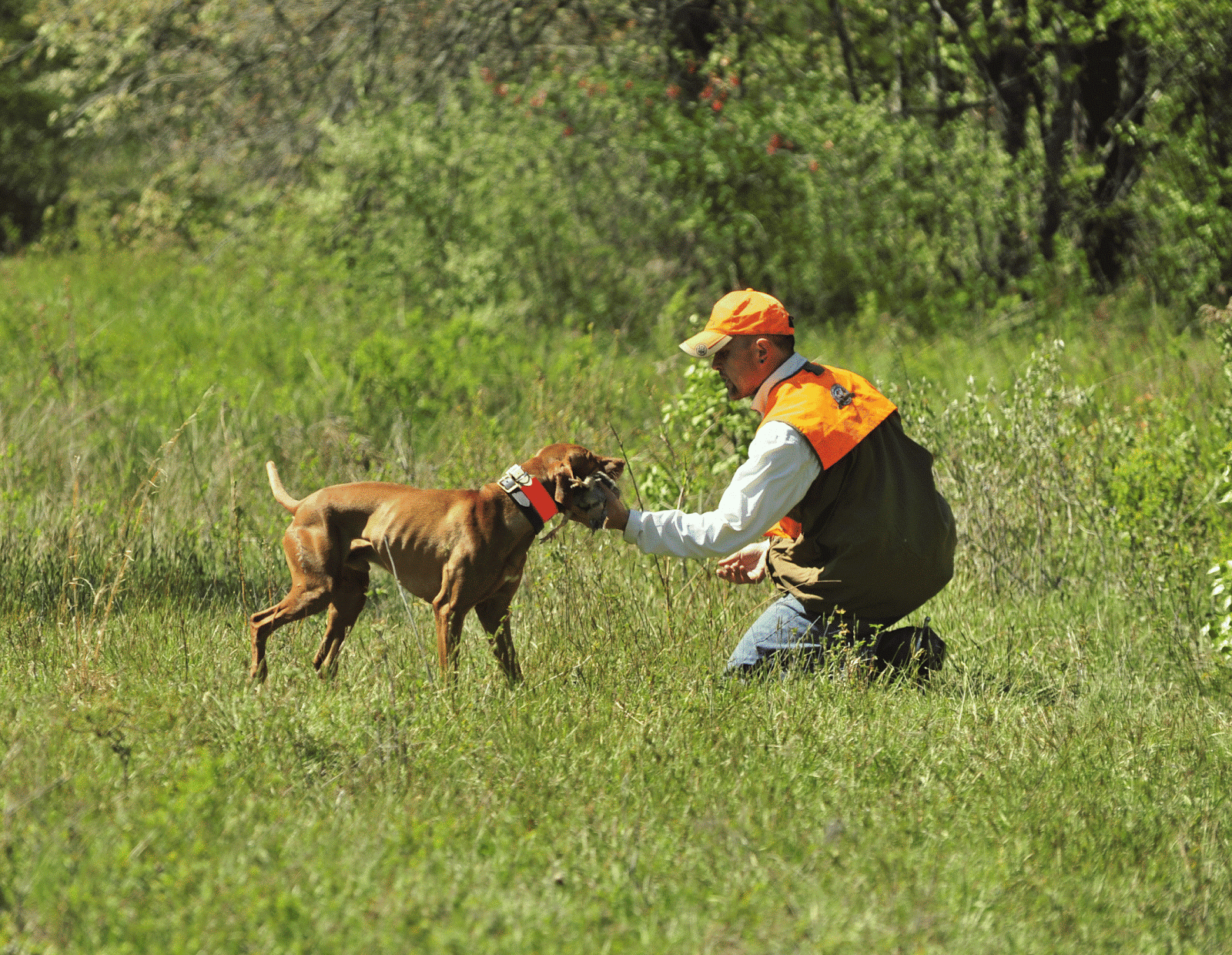
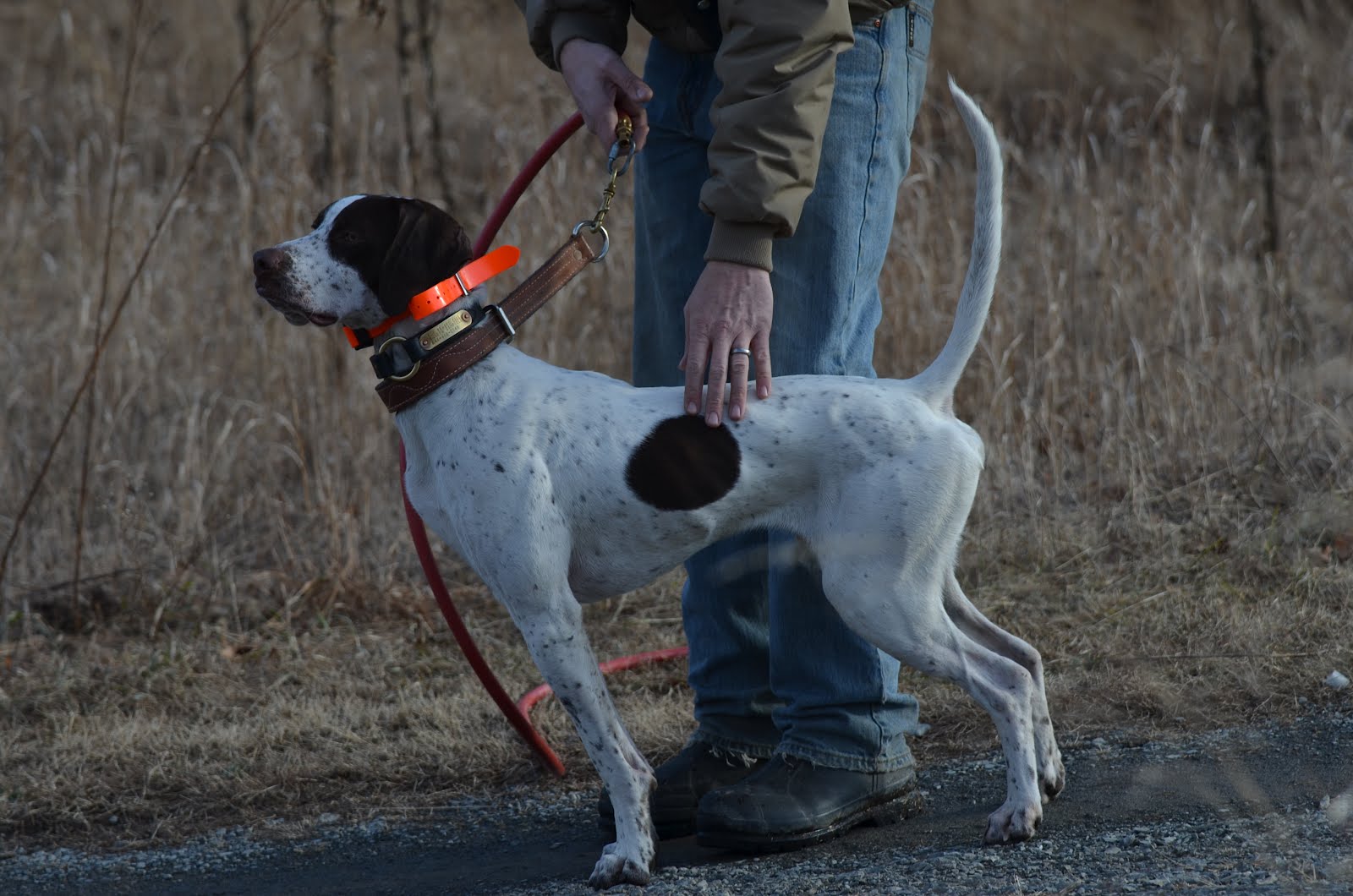
As can be seen in the first picture at the top, Capo seems as though she never left bird camp, even though she hasn't really seen or smelled a bird in easily six months -- and if a pigeon someone eludes the designated 'pigeon spotter' in the crowd, I will use her to do clean-up duty to locate the bird in question.  In my favor, Rye is certainly not afraid of pigeons and learned quickly she could probably catch them -- and so I have been building on those sparks to encourage her to seek out and now establish point on her pigeons, for which she then gets to play retrieve with the pigeon with the broken wing; I have just started asking her to hunt multiple birds and to introduce the pop-gun.  As can be seen in the second picture, she is really beginning to look like the bird dog she wants to be.  Jake is a demon: while I avoid working every dog every day, he has come to realise that he will be getting to do birdwork a lot and his drive has gone through the roof and, as a result, his e-collar 'number' to cue him to stop when he makes a mistake has also leaped multi-fold.   After three weeks here, he is almost perfect on being steady-to-shot and, as can be seen in the picture, his style remains solid; if you click on the picture to make it larger you'll see the carded pigeon sailing off.  And if I remember (and it coincides with going to the public library for internet service), I'll post some of the particular problems I've seen with my crew and (hopefully) post some of the solutions.

Momo is enjoying getting intermittent trips into the woods to look for grouse and woodcock -- and I feel blessed to have reliable bird contacts for him right over the wall.  I have certainly never found such a consistent cover as this one before and am careful not to go in there every day to avoid pressuring the birds too much.  For now Jozsi has been getting lots of exercise, but will be very excited to get back to come and work johnny-house quail and some more woodcock.  I had to take him out of the woods about ten days ago because while the experience of wild birds is as instructive for him as it is for Momo, his enthusiastic bull-in-a-china-shop approach was scraping his face up something fierce.  And for at least one weekend this summer I needed him not to have any actively open wounds because... I handled him in our first dog show.  Since Lisa's passing, and out of gratitude for the dog have from her, I've felt a need to try and keep her name alive for at least a little longer.  For the last two summers, I've been unable to attend the VCCNE Specialty show up in Keene, NH, and so, as one friend put it, I entered him in the conformation equivalent of Amateur Walking Puppy, the 'Field Trial Dog' stake.  I had a pretty good idea there wouldn't be a lot of competition either -- and so while the judge could have hated him or he could have uncharacteristically savaged her, he won his stake of one and now has a genuine non-regular First Place conformation ribbon.

As another friend pointed out, with a number of folks there knowing it was his and my first show, and in a stake of one, the jeering cheering started as we went around, Jozsi suddenly understood the attention was on him and perked right up, the judge started laughing and as a result a lot more people paid attention to one of Lisa's dogs than they ever would if I'd just had him in one of the Open stakes.  With Capo taking 'Field Trial Bitch' and her mother, Lucy, taking 'Hunting Dog Bitch,' not only was it a good day for Widdershins and Skypoint dogs, but as another show friend pointed out, it was actually refreshing to have a full Specialty -- with dogs representing all the offered classes.  If pictures materialize, I will post them for giggles.

Right now, I am wrapping up a final day of work covering other people's vacations -- and can hardly wait to get back up to Maine tomorrow to keep working all these great dogs.

Wednesday, June 27, 2012

silver linings

As the title and delay in posting would suggest, it has been six weeks of frustration waiting for some kind of clear plan or purpose for the remainder of the summer and fall to develop.  Here in New York, all the moisture that you might have presumed to have appeared in January and February and coated the ground in ice and snow waited till May and June.  And so we've had to try and slot things in between thunder storms and increasingly tall covers on our training grounds.

We did manage to fit in another group training day at TMT in the third week of May with Jack, Juli, Scotch, Dustin, Lyric, Gabi, Paige, and the League of Extraordinary Gentlemen.  It was nice to see friends again -- and we were blessed with good weather although a little more breeze would have made it perfect.  But we got everyone run and everyone had fun.  The top picture is of Scotch on just his second set of birds -- as I said to Josh, he's still very young and the fire needs stoking but when he gets scent, he knows what to do.  Look at the tail on that dog!  Fabulous.  For young dogs, I prefer to use birds that are fully awake and placed in spots that require the dog to use its nose.  For younger dogs with less prey drive, I think there's a lot of merit in a handler 'taking the dog for a walk' close to a planted bird -- in part because the young dog associates going with his handler with the excitement of finding birds.  And as the dog associates going for that particular kind of walk, that will also build drive as well as reinforce the desire to work with his handler.

After a great winter starting the breaking process with Jake, we lost our rhythm due to crappy weather coinciding with my days off.  He has been at the point of making the transition from the pinch collar to the e-collar for correcting him when he makes a mistake (ie. fails to stop or needs to be re-cued to stop) for some time -- and my challenge has been that he was simply not making very many mistakes.  Jake seems to have internalized all the external cues for stopping -- pointing, stopping to flush, and honoring -- and was standing very nicely through each of those things while either someone else flushed for him or the dog he was working behind.  In short, he wasn't doing anything to merit being re-cued to stop and stand still.

As I wrote two summers ago about knowing when to stop and when to keep going, my dilemma has been whether to assume he does know it and potentially create a problem by going too fast or to potentially lose style by boring the dog with lessons he knows he knows.  One nice part about the West method is that you're essentially teaching the dog the same skill in a variety of scenarios -- which is to say, you don't break the dog pointing birds, then teach the honor, or the stop-to-flush -- and so in that sense, you can mix things up with the dog by asking him to the same thing, albeit in a different (and hopefully interesting) set of circumstances.  Maurice Lindley had suggested that I use the stop-to-flush as the means to test whether he'd internalized the e-collar cue to stop -- in part because I could do it by myself using a launcher while still keeping myself in a position to correct him with the pinch if the e-collar didn't register.  The challenge remained that he would stop himself properly and then, very often, make little or no effort to move after the bird.  Nevertheless, the advice was sound.  What I've also seen with him is that he seems most reliable on birds he's not pointing, whereas having scent drives him that little bit crazier even if I'm standing by him with the pinch collar and someone else is flushing for me.

Today's silver lining was that I got up to TMT to feed my birds and hopefully get some training in on pigeons with Jake and discovered that, of the five checkcords that I can think of that I own, I didn't have a single one with me -- and certainly not the one with the pinch-collar on it.  I didn't know whether to laugh or cry.  So I cursed.  I had been tidying up all the stuff in the back of the truck and in the trailer and had just plain forgotten to make sure I had one or the other in the truck again.  I had already put out one pigeon in a launcher and two on cards but debated what to do.  The short answer is that part of me wishes I'd brought a camera with me to get some nice pictures of me in front of a high and tight Jake, but then again anyone who reads this blog would have laughed their butt off if they'd seen his regular purple nylon leash hanging off his collar.  He handled his stop-to-flush perfectly, broke on the first pointed pigeon after I'd flushed but I managed to stop him with the e-collar to style him up and reflush the bird, and he handled the final pointed bird really nicely.  And this is one reason I have been frustrated by our intermittent training schedule -- because he handles corrections really nicely -- and wish we could have gotten a bunch of nice even repetitions in.  This is largely what you pay a pro for: the time to establish a routine of (hopefully) productive behaviors.

But the real silver lining wasn't that Jake did well, but that forgetting a key piece of equipment that I would have otherwise used as a psychological crutch in the name of 'taking it slow and steady' forced me to take a chance.  Sometimes you need to have faith in yourself, in the training time you already have in, and of course in your dog.  This picture is actually from a couple of days ago, but he's a pretty happy chappy.

*******

In other news: Craig Doherty at Wild Apple Kennel has written a series of five blogposts on grouse trialing.  Whether you do grouse trials or not, there's a lot of really useful and interesting stuff for trialers in here.

And: I had a nice time judging SH/MH at the Nutmeg GSP Club hunt test a couple of weekends ago and was pleased to watch another set of really nice Spinones.   I realize I'm admitting to a stereotype-proven-wrong, but if there was a breed that has genuinely impressed me in the last year of judging hunt tests it has been these mostly white Spinones.  And not because they performed the skills well enough, but because they looked animated and excited to be doing it.

Also: if you ever send something back to Garmin to get fixed, remember to take out your memory cards or the after-market extended antenna.  I remembered the first but figured they'd just repair the busted screen on my Astro 220... no.  They sent me a whole, newly refurbished 220 back instead.  Fortunately, this is now my back-up unit and the 320 comes with an extended antenna in the box.

Tuesday, May 8, 2012

busier than heck

There's nothing like a good bird-dog addiction to keep you busy -- and April was another good example.  Mid-month, I hosted a training day for a bunch of friends -- including son-of-Sally, Jackson, and son-of-Jozsi, Judd, as well as Scotch, PJ, and the League of Extraordinary Gentlemen.  This picture is of Judd throwing a really nice point during what was only his second time working birds.  It was great to have a bunch of young dogs and watch them figure out what they had been bred for.

We then held our CVVC Spring field trial at the end of the month, for which I served as the chair.  It was my first time chairing a trial and thank heavens for a good group of folks behind me.  In an effort to minimize some of our costs, we elected to run it as a two-day trial and still managed to run 100+ dogs in the course of 48hrs.  On the one hand, it was a little frustrating not being able to accept all the entries received for our Amateur Walking Puppy stake, but on the other, it was truly exciting to see two large Puppy stakes with a bunch of first-time trialers trying their hand at the sport.  Hopefully everyone had a good time running their dogs even if it probably felt a little frustrating to be the last stake of the trial run in the later afternoon on Sunday.  Hopefully, they also came to understand two of the weird quantum physics phenomena of field trialing: on the one hand, even if you don't have many dogs to run, the trial will fill the entire time allotted; on the other hand, even if you do have a ton of dogs to run, your brace won't come soon enough.

After an exhausting weekend of seeding courses, filling bird bags, and marshaling volunteers (all of whom I greatly appreciate), it was especially rewarding to read the placements for that 14-dog Amateur Walking Puppy stake and to hand over the blue ribbon to my friend, Kim Barry, and her exciting puppy, Zoom, who is out of Kyler and Rene Blakemore's very handsome Dual Champion, Remington.  As you can see in the above picture, our club has a special trophy for the highest placed Vizsla in our Amateur Walking Puppy stakes in memory of a much beloved, much missed club member, Saul Himmelfarb.  The Open Limited Gun Dog stake also has a rotating trophy in memory of another lost-too-soon club member, Patrick Cooke, the owner of the great Yogurt.  Yogurt is an aunt to our Jozsi through her mother, Shaker, and so it feels especially rewarding to announce that Jozsi won the OLGD stake for 2 retrieving points towards his FC.  A big thank-you to Dave Margolin for taking the picture of his successful retrieve.  After a lovely long cast, he had a stop-to-flush, then quite literally a limb find -- a bird 4ft up on a branch -- which he handled beautifully and then hunted and searched like a madman for the remainder of his brace.

What follows is not to brag about me or my dog (in part because it's based on a compilation of several observations) but to hopefully encourage folks to think about what they're doing when they're trialing.
  • Your dog needs to point a bird to place, but one spectacular find might trump a half-dozen ugly finds;
  • If your dog finds a gazillion birds, then it simply doesn't have time in a 30minute stake to really demonstrate speed, range, and/or confidence;
  • As a handler, you're putting on a show for the judges -- and whether you are or not, try to make it look like you and your dog are working as a team;
  • If your dog has faults, then don't give it the opportunity to demonstrate them by trying to show its strengths instead;
  • At some point, you will probably have to make a tactical decision about what is better for your dog's performance: if my dog has already had positive finds, does it make more sense to take an unproductive at the end of a stake rather than try to flush one more bird that might run or fail to fly or flush back into your dog's face?
  • AKC weekend stakes might only be 30minutes long, but everything else being equal the dog that finishes looking like it's just warming up should place higher than the dog that looks like it's happy to be done.
This past weekend I was out in central PA at the GSPCA National Amateur Gun Dog Championship held at Warrior's Mark Wingshooting Lodge -- I think largely because I can ride a horse and am a fairly good shot.  For the first 30min series of the championship, every dog with birdwork had to demonstrate a successful retrieve -- with the first chukar encountered shot-on-course where possible.  Maybe because it was an amateur event, maybe because it was a single-breed championship, but the atmosphere was very supportive and encouraging.  For me, despite the slight pressure to shoot birds absolutely dead, it was a great opportunity to meet a bunch of new folks and to see a bunch of very nice dogs.  It was an honor to shoot birds for all the dogs and especially those that made it through to the second series (which was a 45min brace with all the birds being pop-gunned).  And while congratulations go to all the dogs that placed, it was very nice to see that Greg Nicholson and Greta took a 4th place and that our dear friends, Jen & Dennis Hazel, won the 2012 GSPCA NAGDC with their fabulous little dog, Raven.

May will hopefully be fairly quiet -- although I have just committed to hosting another training day.  June will be busy with three judging assignments on back-to-back weekends, two field trials and one hunt test.  In between all of that, hopefully we can keep working on breaking Jake and keeping Jozsi on track to finish up his title sometime soon.


Monday, April 9, 2012

where did spring go

As ever, it feels like I have to start a blog post with an apology, but sometimes writing really does have to take a second place to more important things like dog training, dog exercising, judging dogs, watching dogs, and trying to make plans to do more of the previously mentioned.

The beginning of March saw the League take a road trip down to Sumerduck, VA, for the Conestoga Vizsla Club spring trial -- and while none of them were actually entered, I made my debut as a field trial judge judging three of the juvenile stakes. In much the same fashion that I actually enjoyed my apprenticeship period as a judge, I also enjoyed the opportunity to share opinions with my fellow judges and learn some more about how they assessed the dogs in front of us. While I know that you will most likely only make one person happy with your decision, I'm finding the opportunity to look at so many dogs with a different kind of eye also makes me look at my own a little differently, too.

And in terms of perspective, I was also lucky to have lunch with someone with second-degree knowledge of several of the dominant field trial pointers of the pre-WW2 period. I wrote about it here at Living with Bird Dogs -- but it was neat to learn a little more about Mary Blue, Norias Roy, and their owner, Walter Teagle. While certainly from a subsequent generation, I was lucky to spend three days with Fred Rayl, son of Hall of Famer, Bill Rayl, at the Armstrong Umbel Endurance Classic way over in Guys Mills, PA. After the first day's running, sitting around a dinner table with various people, a discussion about pedigrees, breeding plans, and famous dogs inevitably occurred. Suffice to say, while one person was trying to tease out where the Rambling Rebel line had emerged and prospered, Fred asked him if he knew who owned Rambling Rebel's most famous daughter, Nell's Rambling on? The other person said "no," to which Fred replied, "My daddy." There was no ego or oneupmanship in the entire conversation -- and the answer brought plenty of laughter around the table. It should be noted that, in addition to her own election to the HOF, Nell whelped two other sons who have also been recognized to this same degree: Guard Rail and Addition's Go Boy.

Going back to the Armstrong Umbel to report the trial was a treat. The admiration I felt last year for the handlers, trainers, and owners was no less diminished, but I had a greater sense of what I should be looking for to capture for the official report for the Field. It was also nice to see many of the same folks I met for the first time last year again -- including Joe McCarl and Marc and Scott Forman. This year's trial was no less a game of faith than the previous year. If you go into the 'Galleries' section, you can see some of Chris Mathan's great pictures from the trial here at the Sportsman's Cabinet.

While it was sad to learn that his father, White Powder Pete, had passed away at the beginning of the month, it was great to see Jake's mother, Hard Driving Rita, run and lay down a powerhouse race for her two hours. I wish I could have met Pete in person and seen him run in more than National Championship DVDs -- but it was also really nice to see how much of Rita is in Jake, too. Jake had a family reunion of sorts, as well, with his brother, Hard Driving Mo (owned by Joe), and his sister, Hard Driving Dot. Dot is owned by my now friend, Brian, and is as much the firecracker as her brother; she actually went on won the 22-dog Venango Puppy Classic the weekend after the Armstrong. As you can see, these pictures came from Chris Mathan who co-bred the litter with Colvin Davis: Mo is the upper dog, Dottie the lower.

Since I started writing this post, I was also sad to see that Bert Wimmer, Pete's owner, had also passed away right around the same time. The Wimmers, both Bert and his father, Walter, were an integral part of the Indiana field trial scene for over a half-century. Here's hoping that owner and dog are reunited in a better place where the riding is easy and the quail plentiful.

In other news, I have also begun my spring hunt test judging assignments, this past weekend up at the Swift River Sportsman's Club for the Central New England Brittany Club weekend, judging SH/MH the first day and JH the second. I had the whole League with me in the Luxury Cruiser and was able to get in some nice training runs with all of them. Momo is... well, Momo... not quite enough ooomph or style to be a trial dog, but if you ever need birds to be found, he's the doggie! Jozsi is actually starting to act like he's a broke dog: his final find at Swift River in three-foot tall pines on top of a stone wall a piece of brilliance. I walked around him twice, trying to use the Astro to locate him, and then realized I should probably just kneel down and try to look under the evergreens to find his feet. And he stood the whole time when he had plenty of opportunity to be a jackwagon. He's even starting to honor of his own free will (!?). His tail issues haven't entirely disappeared, but I suspect that the more reps we get in where he does well and earns praise, the less frequent that little tick or wag will become as he realizes that if he stands there and lets me flush then he'll get both a) to see the bird fly and maybe even get to retrieve it, and b) he'll get love from his pop. Mark Coleman at Wingshot wrote a nice piece recently about his own experience with patience in dog-training -- and I hope Jozsi's increasing willingness to do what I want and to make it his own is the product of my patience with him. As for Jake, he's taking to the breaking process really nicely, again, I hope the product of the 'slow is smooth, smooth is fast' approach I learned from being out in AZ with Bill Gibbons. For those of you familiar with the West method, we're about at the point where we transition him to cues from the e-collar if he chooses to move after he's stopped himself. This picture is from our weekend at Swift River and, as you can see, he's showing tremendous restraint for a young dog sight-pointing a quail running in the open.

We have a big training day planned for this coming Sunday and hopefully we'll have a bunch of pictures of a motley crew.

Saturday, March 3, 2012

short days and a chance of snow

Meg and I just got back from our annual February vacation. We had entertained going to Morocco for a while, but for those of you who follow this blog know, we have a perverse fascination with going to cold places in mid-winter. And so, we went to Iceland. Of course.

I don't mind admitting that I have had an Iceland fixation since reading my father's copy of Desmond Bagley's Running Blind in the late 1970s. I haven't read the book in maybe thirty years, but I can tell you that there might have been all kinds of references in that book to active volcanic activity (like the creation of the island of Surtsey in 1963), but I remember river crossings, Land Rovers, and that the Russian KGB agent drank calvados. In any case, compared to our flights to Mongolia, the Ukraine, and Sweden, a five-hour direct flight from JFK to Iceland looked both easy and, frankly, cheap. And admittedly, while the population of Iceland is only about three-quarters of the population of Staten Island, and so small scale makes things a lot easier to coordinate, Keflavik is one slick airport some 31miles from downtown Reykjavik. Stylistically, it was reminiscent of the Ikea-type experience we had in Stockholm despite its shared history as a big-bomber USAF base. Buses to and from the airport are coordinated with the flight schedule so while there are taxis waiting, there's actually really no point to taking one unless you're going someplace other than Reykjavik.

As with our trip to Sweden, we decided to base ourselves in one place and make short overnight trips elsewhere -- in this case, staying at the Radisson Blu 1919 downtown which was perfect for us. (I just made the mistake of looking at some people's reviews of this hotel and am a little surprised by some people's expectations: it's an urban Radisson, it's not a boutique froux-froux hotel; it's in Scandinavia, what kind of decor do you expect?; it's a downtown hotel on an island in the middle of the North Atlantic, would you like cheap with that, too? please don't go out to eat anywhere because that will really wreck your budget; room check-out is 12noon, how is housekeeping going to get your room ready when you arrive four hours before that time?) In short, the location is great to walk to museums, shopping, restaurants, and probably even the bus station if the weather was a little nicer; the staff were unilaterally extremely helpful and imminently more fluent in English that we will ever be in Icelandic. That latter observation goes for Icelanders in general, too, and when you do completely mangle a place name, they all seemed to laugh it off with a lightness that comes from a certain cultural self-confidence. Incidentally, the first picture on the right is taken from the top of the Hallgrímskirkja, the striking Lutheran church in the middle of the city. The dark-grey boxy-looking structure three-quarters of the way up the picture is the Harpa, Iceland's new, premier concert hall. I can only describe it as being like a TARDIS: on the outside, it is certainly innovative with its angled panes of colored glass that mirror and mimic the sea that surrounds it, but once you get inside, it is massive and light at the same time. And I just saw that Buika is playing there in early June -- might be time for another trip!

In addition to a couple of side-trips to the Vestmannaeyjar and then to the peninsula we abominated to 'Snuffaluffagus', and after our equine excursion in Sweden, I was determined to ride an Icelandic horse in Iceland. From what I gather, Eldhestar might be the largest horse-riding outfit in Iceland and, whether cause or effect, actually does offer riding year-round, is close enough to Reykjavik that they'll pick up at your hotel, and has access to enough space that you really do get ample opportunity to get your horse up into a tölt. I wanted to ride and have sat in a cold saddle enough that if I'm going to do it, I'm getting as much saddle time as I can. And my darling wife is a trooper -- and as you might imagine, we were the only two people signed up for a full day-tour. (There were actually a bunch of people who came through for a one- or two-hour ride while we were there which was pleasantly surprising.) Meg was pleasantly relieved that we would come in for lunch after about four hours and that she could then stay inside and stay warm. This was especially relieving after we watched our ridiculously upbeat guide literally break the ice for us on our way back in to the stables: we had to cross a slow-moving, but three-foot deep creek with pretty solid ice shelves on the entry and exit; after coaxing her horse into and across the river, it decided to try to stand up on the ice shelf on the exit, stumbled, and dumped her. But here's the happy picture of us all bundled up in our coveralls. (Incidentally, to protect the indigenous horse population of Iceland, you cannot bring used horse tack or clothing into Iceland without a certificate of sterilization from a vet.)

I don't know if it was anything other than the remarkable pictures in the various Rough Guides and Lonely Planets that made us decide to go to the Vestmannaeyjar, but we're sure glad we did. Truly an an archipelago, only the largest island, Heimaey, is inhabited and dominated by its safe harbor and fish processing factory. But the northern end of the island, and which provides such a safe harbor for its fleet, is surrounded by high cliffs that seem somehow more Pacific than Atlantic. This picture is looking northeast from the edge of the lava field from the 1973 eruption of the Eldfell volcano towards Elliðaey and the massive Eyjafjallajökull glacier, also infamous in recent history for being the site of the 2010 eruption that disrupted plane travel across Europe for over a week. Being on Vestmannaeyjar in February was a little like being in Mongolia the first time: while no-one (understandably) asked to touch my beard admiringly, we were the two tourists. There was a Japanese guy there, too, but he was there to buy 'caviar' (which I took to be roe) from the fish plant. We were nevertheless treated with the utmost hospitality, almost apologetically in fact, by the brand new owners of the hotel we were staying at -- apologetically because they had literally just taken ownership of the hotel, were in the midst of renaming it and literally tore out the old dining room while we were there. But their kindness and introduction earned us a free car tour of the island from another friend of theirs (which was appreciated because it was raining when we first arrived) and a ride to the far end of the island the next morning. But it was something of a Central Asia experience: we wanted to go into the Folk Museum but being winter, it was only available by appointment. It was in the public library so Meg, with her usual aplomb, just asked if we could get in. The curator was off-island, but a trusting surrogate took us up, turned on the lights, and then left us alone to wander through (and in that regard, it was not like the Aimag museum in Choibalsan where we were shadowed by a Mongol grandma who turned lights on and off as we entered and exited each room). And so we learned about the history of the fishing industry, the Turkish pirate raid in 1627, the 1973 eruption (which had a great video collage of survivor's reminiscences, and the surprising percentage of Vestmannaeyjar residents who made their exodus to Utah to join the Mormon Church. While it took even the very helpful receptionist at the Radisson four phone calls to figure out the details (it being winter even website updates get delayed), the Vestmannaeyjar were easy to get to by bus and ferry from Reykjavik to Þorlákshöfn. Like any small island destination, I probably wouldn't want to go there in summer to avoid the extra people -- but having the place to ourselves albeit with a fair amount of drizzle was just fine.

After another brief stop-over in the big city, I got to fulfill my Desmond Bagley fantasies and we rented a Land Rover Defender to drive up to the Snaefellsnes peninsula to stay at the Hotel Budir. All hype aside and the fact that from the exterior the hotel looks a little boxy and otherwise not too distinctive, this was a fabulous place. Cosy, exemplary customer service, and the food fantastic. And the location, on a river estuary, with a view of the waves breaking on the beach from the lounge, and a backdrop of steep-sided mountains topped by Snæfellsjökull, the mountain and adjoining glacier. The picture on the right is of the old Lutheran church and graveyard a few hundred yards from the hotel, the walls of the yard made from lava boulders topped with sod.

Leaving aside my boyhood memories, we had rented a Land Rover because it was winter, after all, and the weather unpredictable. Happily, too, I have driven in snow in Maine, Michigan, and Oregon -- otherwise, even with studded snow tires and 4WD, I might have soiled myself coming over the mountain road to Ólafsvík on the northern side of the peninsula. It wasn't that it was snowing as much as it was a winding road with no guard rail covered with ice that you could see was at least an inch thick in places -- oh, and it was gusting about 40mph. And then the road went from hardpack to gravel about three-quarters of the way down. Time for third gear all the way down. I had forgotten that Snæfellsjökul is the origin point for Jules Verne's A Journey to the Center of the Earth (1864), but I am not surprised; nor were we surprised to find The Hobbit Inn in Ólafsvík. The whole vacation was a little bit like being in a Peter Jackson film. However, in another Mongolian moment, reminiscent of the ginormous long-wave antenna in Bayan Olgii, we also saw the massive radio mast at Hellissandur, the tallest structure in Iceland. The picture on the right was taken on the beach below the radio mast and illustrates the wind speed pretty clearly -- but it was really neat to walk on a black lava pebble beach despite the gale-force gusts.

Incidentally, the best town-name-for-a-death-metal-band was also on Snaefellsnes: Hellnar.

In short, we had a great time, saw some incredible scenery, stayed in nice warm hotels, and ate like champions. There are several very good restaurants in the downtown 101 area of Reykjavik: our favorite was Fish Company. I like actual food and will admit skepticism towards foams and vapors and freeze-dried who-knows-what à la Ferran Adrià -- but leaving aside how good all the hormone-free, fresh-caught meat and seafood tasted, my deconstructed tiramisu was phenomenal. Twice.

Sunday, January 29, 2012

happy new year

Since I last wrote, we've only been able to get out and train a couple of times with the League. Between trying to find windows in the weather and coordinating various friends, it's been a challenge. Arguably the biggest hurdle to training using the West method is one of manpower -- and it is no wonder that a lot of folks migrate to something like the Rick & Ronnie Smith method with its utilization of 'whoa posts' and such. And I mean no disrespect to the Smith family who have trained more great dogs than I ever will -- but I have seen the West method and it makes sense to me. Even though Maurice Lindley has figured out ways to train dogs by himself using the West method by using launchers, I know that he prefers to work dogs with a group. Fortunately I have been blessed to have found friends with broke dogs to work behind and others with puppies who can also flush and shoot.

I recently wrote a small piece for a Vizsla Club of Long Island newsletter which, in short, hopefully encouraged folks to get their dogs out and do fieldwork with them. One of the highlights of our training trips has been watching Jeremy and his puppy, Jackson, really come along as a tag-team. Jackson is from the most recent litter out of our friends', Jen + Dennis Hazel's, Sally. His whole litter are looking like bird-finding machines and there is no shortage of drive in this little dog to the extent that I asked Jeremy what he wanted to do with his dog -- did he want to play the field trial game? did he want him to be a hunting dog? These aren't exclusive categories, but to my mind I'd develop a pup a little differently if I knew I wasn't going to play the trial game. As I've said in previous posts, my goal with Jake was to establish a handle on him -- but if I had also intended him to be primarily a hunting dog, I'd also be working on limiting his range when I turned him loose. (And so, for example, when Jake lights out on a cast when we're out for a walk, I keep singing him out and only really reel him in if he's headed off in a drastic tangent or headed behind me.) I think it's also easier to encourage a dog with drive to stretch once they're broke, than it is to try and hunt with a free-running, green-broke dog. And so Jeremy and Jackson have been doing long-line work to really encourage the pup to go with him and not hunt independently -- and in doing so, to be rewarded by bird contacts.

We had run Jackson on johnny-house quail and after still managing to catch a couple and seeing his intensity, we decided it was time to get him on a checkcord to develop his handle and nurture the idea of working with his handler. The last time we got together (which may have been two weeks ago), we tried using chukar with flight limiters -- but the challenge I've had doing that is that there is a huge variance in the relative strength of chukar and if you weight the limiter too much they can barely fly and then you end up with a very expensive, dead training bird, too little and you lose both the limiter and the bird. And to my mind, the goal at this point is to have birds that will fly promptly when a pup charges in on them (and have the checkcord stop them after the flush, not before). Because Tom's property is much more wooded than the desert plains of Arizona, I was wary of using carded pigeons -- but decided we would give it a go. Now sometimes it's important to make your own mistakes so you know why the guy you've spent three months apprenticing with in the last year does something the way he does. And that thing is: don't sleep the pigeons. We had some concern the pigeons might disappear before Jackson and John & Linda Morris's pup, Dustin (whose handsome picture is alongside), or that if the pups came across the birds walking in the open they might be less inclined to point and more inclined to chase. But here's the thing: if a dog tries to chase up a healthy bird and it flies when the dog gets too close, the bird will get away and then the dog will get checked by the cord; if the bird can't escape quickly enough because it's dizzy, the dog maintains the hope that it can grab a bird on the ground and will probably keep trying longer.

This was where I was with Jackson, concerned that he might be turning into a diver, emboldened by his successes. And I mean this as no slight on him or his owner, but this is a young dog with a ton of drive and if others will read this and see parallels in developing their own dogs and so avoid a few hiccups, then all of this disclosure will have served its purpose. And so, Jackson got to run on fully awake carded birds -- and as much as I will try to encourage young dogs to find their first birds with their noses, the important thing to consider when beginning to encourage a younger dog to establish a solid point and stand is that whether it's a hunt test or a hunting situation, if it comes across a bird in the open, it is still expected to sight-point. But whatever it was about the pigeons, whether they were deep in tall grass or walking in the road, they stopped Jackson in his tracks. And he stood really nicely all the way to the flush. I was so very pleased with both Jeremy and Jackson. The next question for Jeremy is how he wants to break his dog now that we've started down this path.

By contrast, Jake has started down the West method path and is doing great. This was his third time being worked behind John's Juli -- a very pretty dog I have been braced with and who I was fortunate to judge in both SH and MH. And it was great to have Jeremy there to be the designated gunner so that Juli could also get a nice chukar retrieve or two. The amazing thing with the little white demon (who has now weighed in heavier than Jozsi!) is his natural inclination to honor -- and sometimes from so far away that he has already figured out the context for a situational honor. Again, while a judge might ask him to move up in a hunt test sensing it was not a true honor of another dog's point, in a field trial a situational honor is as good as any other -- and I'll take it. What I hope this picture (courtesy of Linda) illustrates is multifold: first, this dog has style; second, he is wearing all his work clothes -- his e-collar and his pinch-collar; third, that there is very little tension in the actual checkcord and collar as evidenced by my loose grip; and fourth, that he is being rewarded by two things for standing still -- the sight of a bird being flushed and a gentle reassuring pet before being moved on. At this point, I touch him more than Bill does, meaning that if a backing situation is becoming complicated and taking time, I will gently stroke his side in the middle of it in addition to petting him and tapping him on the side to move him on once we're done with a situation.

To round out things: I've been trying a new twist on things with Jozsi, adding a little more pressure and adding a much bigger reward. If it works out, I'll post specific details -- but suffice to say, he's being kept to a higher degree of honesty and in return, he gets birds shot for him which he then gets to retrieve. He is broke in practice, but I think that once he's actually broke in his head then all his tail issues will disappear -- which is to say that I think while he knows what I want, he hasn't settled the issue in his own mind that this is also what he wants to do. On the upside, while it's not quite a Master Hunter quality retrieve, his retrieve is solid, to-hand, and will hopefully satisfy field trial judges should he get called back.

Like Bill said to me, two summers ago, "If you can get him straightened out, you'll be able to genuinely call yourself a dog-trainer." If breaking Jake is all about starting a dog right the first time, then Jozsi is a conundrum that is so very worth the challenge. I love all three of the Gentlemen albeit for different reasons, but Jozsi is such a goober that you can't help want him to be fantastic.

Thursday, December 15, 2011

missing in action

Apologies to the faithful followers of the Regal Vizsla for my absence. On the one hand, we've been busy and any time spent outside with birds and dogs is good time spent. Since I wrote last, we've been to a couple of trials, taken our annual trip to western Maine to chase rumpled grouse, and started to break Jake. All in all, a pretty busy schedule.

The first few days of November we went over to Flaherty to support the Mayflower GSP Club's first field trial in many years. Congratulations to all the folks there who contributed to making it a well-run, enjoyable event. Momo did his usual, not-quite enough horsepower performance and we both had fun; Jozsi ran in an uncharacteristically odd fashion, was honest but didn't look great on his birds, and took 3rd in ALGD; Jake suddenly decided he likes to run.

The transformation of this little pup from the excited little gun dog who ran at Conestoga to the horizon-seeking demon was remarkable. I was genuinely surprised. And very very happy. He showed his intensity, his application, and his handle and left me just remarking at how much he must have inherited from all the great dogs behind him. My plan for developing him has been pretty simple: establishing a handle on him, giving him just enough birdwork to see what his style looks like and to keep him hungry for birds, and to break him to the gun. I did enter him in a JH stake and I will say no more than he got hosed. But the intent had been to see if he would stick with me without singing him too much, to run him with a bracemate, and to reassure myself about his being broke to the gun. In that regard, he exceeded my expectations.

Know the rules: you may not be able to change a judge's mind, but you'll figure out quickly whether you'll run under him or her ever again. After the fourth invalid reason for his non-qualification, I realized the judge was either not looking at my dog or had forgotten the standard for Junior Hunter. I do believe there is merit in JH for any pointing dog, whether they are going to be trial dogs or hunting dogs -- and my plan had been to get Jake broke to the gun and then run him while he was wicked young just to get him fired up and used to running with a bracemate. From his first trial down at Conestoga to his JH run, he has shown no interest in his bracemates whatsoever. But with the summer getting all messed up due to the Wallow Fire, Jake's development was a little out-of-synch with the plan, and with the JH title really being a means to an end, his 'not-qualifying' run was disappointing and will probably be his only run at that title. In short, I got a pointer because I like their style and, frankly, I wanted to see what it would be like to try and raise a potentially all-age dog. And trying to handle a young dog into a small birdfield four more times for the sake of a introductory level title doesn't fit the plan in the long view.

*******

After the Mayflower trial we headed up to Widdershins to pick up Miss Capo and take her for a ride in the Luxury Cruiser. It was hard to imagine that it had been four years since we were there the last time when I went up to pick up Jozsi -- but it was great to see Chris & Wendy, to see all the renovations they've made to the farm, to get reacquainted with Munro (the ridiculously ripped cat), and to meet the goats, cows, and sheep. We headed over to our usual spot around Oquossoc and waited to meet up with our friend, John DeSantis, and his great young vizsla, Luna. Unlike all four previous years, the weather was in the 50s with bluebell skies -- no hint of snow or rain in the air -- and it proved to be a real challenge when it came to finding birds. Luna ran over a bird in our first cover which I shaved some feathers off, but which otherwise left unscathed. And then we hit a drought. We saw a few other birds, but I don't think either of us fired our guns in the next day and a half. I felt bad for John who could only stay 36hrs, but I guess this is why they call it hunting. The picture here is of Luna standing behind a couple of trees scarred up by fresh moose scrapings.

Nevertheless having five dogs to run, I left with a whole new-found appreciation for pro trainers like Joe McCarl who specialize in field-trial cover dogs. We were certainly able to pair some dogs: Momo, Luna, and Capo are pretty evenly matched; Jake & Jozsi seemed like it could work nicely, too. I wasn't smart enough to get data off my Astro to figure out what I actually walked, all I know is that I walked for four hours straight the first afternoon and then had two seven hours straight days after that. What I did discover was that pairing Jozsi and Jake was akin to dedicating profound faith in the battery life of the Astro and the ability of the whistle to penetrate grouse cover. Our little dancing pirate clearly enjoys a little competition -- and Jozsi was not up to the task. In the cover I shot 'Grousezilla' two years ago, John and I watched Jake tow Jozsi out past 500yds before Jozsi clearly realized he was further out than he felt comfortable. After another hundred yards, and realising he was about to crest a hill, I hurriedly chanked up the path and ultimately needed the e-collar to get his attention. I don't want to imply that Jake was blowing me off, I genuinely believe that he couldn't hear me in his excitement at that distance -- but again, with all the work I've put on him developing his handle, and getting him used to the e-collar, he knows my touch well enough to know the difference between being punished and being cued and showed up shortly thereafter cheesey grin on his face and happy to see me.

(Of course, as we all walked back to the truck, in much the same spot that I missed an easy bird two years ago, John and I were caught entirely off-guard by a grouse that had sat tight through two dogs running past it but which popped off as we walked by in conversation. We quickly christened this the 'FU Bird'. I resolved to come back for it the next day with Mominator and The Princess.)

John then left and I resolved to find more birds the next day. I took Momo out early by himself, carrying my precious Grant sidelever, hoping to find birds still on their night roosts and hoping to extend the life of this beautiful gun. We found nothing in the strip of cedars along the path, no trace of the bird Luna had flushed the day before, but as I rounded a corner where Dudley and I had both missed a bird over Momo four years before, there he was 25yds ahead pointing with a 90degree bend in the middle. I snuck toward him, cocked the hammers, and when nothing flushed, I relocated him. The bird must have left its roost shortly before Momo got there and kept moving as I came up because as we then headed off in a new direction, we heard the bird flush off to our left.

Jake had actually had a spectacular point on a grouse the day before, looking just marvelous all the way through the flush (which I can only credit to the genetic payload that he carries from his mother's side and especially his grandmother, 7xCH Hard Driving Bev). But I felt bad for Capo who had, so far, failed to have any bird contact. This picture is from our failed attempt to find a new cover, but it was a neat downed tree and a good place to take a quick break. Sadly, the closest she got was a nice honor on a stopped-to-flush Momo after we went back for the FU Bird. Jozsi redeemed the team the final day, too, stopping-to-flush on a grouse in what I call Momo's Rain Cover and then repointing it in a tree with wonderful intensity. We were past being terribly sporting at that point and one tossed branch later, the bird came down -- it's crop full of clover leaves like all the birds we've taken in November. The sad statistic was that in the indian summer weather we had a total of 9 birds moved in two-and-half-days.

*******

After a couple of judging assignments, the first weekend of December meant our Connecticut Valley Vizsla Club all-walking trial -- and the joys of bird-planting and hosting the raffle and trying to fit in running the dogs between all that. Although a little out of sequence, to summarize: Momo wasn't going to be a contender anyways, but got picked up early somewhat uncharitably; Jozsi acted like a complete ass and I didn't need to be told to pick him up; and Jake ran like a real champ. And won. All I can say is that we'd put the work in and he and I have figured out our timing so that I can let him make a good cast, anticipate a turn in the course, and then sing him around without having him necessarily lose ground. And so, with a win in both AWP and OP, he is done with Puppy stakes and the process of breaking him begins.

My plan is not to run him in Derby till I feel like he is virtually broke -- and then either till he has his Derby points or till he starts obviously misbehaving and acting on his own behalf (whichever comes first).

*******

Since we all came back from Arizona, I began working with Jake just using his regular leash and collar to get him used to the idea of a small tug as a cue to stop and stand still. (This is in addition to the more general, good citizenship kinds of routines where he isn't allowed to leave his crate or step through the front door until told and to stand to be wiped down when he comes in from a run in the woods.) We have since transitioned to the checkcord and pinch collar as part of his regular yardwork -- and also to the whistle as a cue to stop-and-stand-still. For us, the whistle cue to stop is an important one in our life here in the Bronx where we never know when we might need to stop and/or corral the dogs when we encounter a deer/a paintballer/a drunk/a park ranger/someone looking for random stranger sex. In any case, we've also begun to overlay the e-collar over both the whistle and the pinch collar in preparation for his actual birdwork.

And that began this past Wednesday. We were lucky to have both Jeremy + Jackson and John + Juli + Dustin. While Jackson and Dustin are still puppies, Juli is a MH qualified dog and a great candidate for Jake to learn what 'working behind' means. He's already shown some fairly natural inclination to stop-to-flush (which he actually displayed earlier that morning on an exultation of mourning doves) and to honor (which he did rather humorously on a birdhouse in his first trial down at Conestoga). But now it becomes about combining natural inclination and structure. And he did a great job -- and while this is a wide-angle lens, he has already figured out the cues for either a situational back (on the humans) or an actual honor (on Juli) even at some distance. Exciting stuff, for sure.